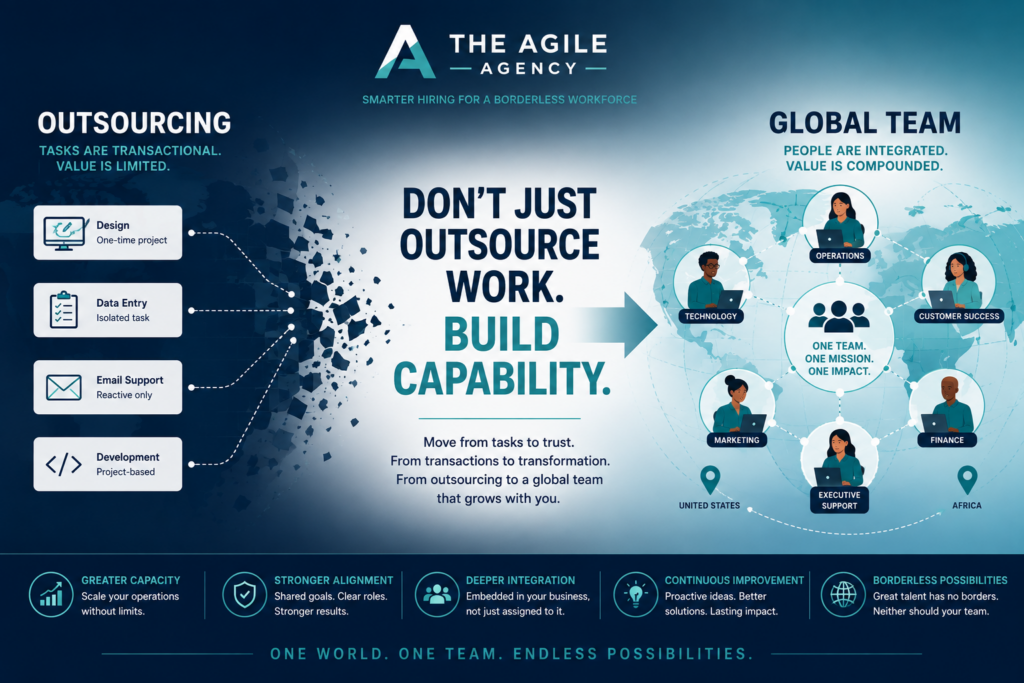
For years, businesses approached international talent with a relatively simple objective:
Find someone overseas to complete a task for less.
Need graphic design? Outsource it.
Need administrative support? Hire a virtual assistant.
Need software development? Send the project offshore.
That model helped introduce thousands of businesses to the possibilities of a global workforce.
But it also created a misconception that still influences hiring decisions today:
Global talent is primarily a source of outsourced labor.
It isn’t.
As businesses become increasingly distributed, the greater opportunity is not outsourcing more tasks.
It is building integrated global teams.
And the distinction matters.
Outsourcing Solves a Task. Team Building Solves a Capacity Problem.
Traditional outsourcing is usually transactional.
A company has a need.
Someone completes the work.
The engagement may end when the project ends.
There is nothing inherently wrong with that model. For specialized or temporary projects, it can be extremely effective.
But businesses often attempt to use the same model for work that is actually ongoing and operational.
That is where problems begin.
Customer relationships need continuity.
Operations require institutional knowledge.
Executive support becomes stronger as someone learns how leadership works.
Marketing improves when the person executing it understands the company’s voice, audience, and strategy.
These aren’t simply tasks.
They are business functions.
And business functions benefit from people who become part of the organization rather than remaining permanently outside it.
The Difference Between a Vendor and a Team Member
Consider two professionals performing similar work.
One receives individual assignments with limited context.
The other understands:
- The company’s objectives
- The customers it serves
- How their role contributes to growth
- Who owns adjacent responsibilities
- What success looks like
- Which priorities matter most
Both may be talented.
But their ability to contribute strategically will be very different.
The second professional can eventually anticipate needs instead of simply responding to requests.
That is where global hiring begins creating significantly more value.
Institutional Knowledge Is an Asset
One of the least discussed advantages of employee retention is accumulated knowledge.
Over time, a strong employee learns things that rarely appear in an SOP.
They understand why a particular client prefers a certain approach.
They remember why a process was changed six months ago.
They recognize patterns.
They know which problems require escalation and which ones they can solve independently.
They understand the founder’s priorities.
That knowledge compounds.
Constantly rotating contractors and freelancers can mean constantly rebuilding it.
Businesses should consider institutional knowledge an asset—and design their workforce accordingly.
Integration Changes Performance
If companies want global professionals to perform like members of the team, they must integrate them like members of the team.
That means giving them more than assignments.
It means giving them context.
Strong global teams need:
Clear Roles
Employees should understand what they own, where their authority begins and ends, and how performance will be evaluated.
Access to Information
People cannot make good decisions without context.
Relevant company information should not remain unnecessarily concentrated with leadership.
Communication Infrastructure
Global professionals need to know how, when, and where the organization communicates.
Professional Development
If someone is expected to grow with the company, the company should also invest in their growth.
A Path to Greater Responsibility
High performers should be able to earn greater autonomy and responsibility over time.
That’s how a hire becomes an organizational asset.
Global Talent Should Not Mean Second-Class Talent
There is another mindset companies must leave behind.
If an employee happens to live in another country, that should not mean they receive less respect, less communication, less development, or less consideration than domestic colleagues.
Geography changes where someone works.
It should not determine whether their contribution matters.
If companies recruit internationally solely because they believe workers in another country will tolerate poor management for lower compensation, they may fill positions.
But they will struggle to build exceptional teams.
High-performing professionals have options.
The best global employers will understand that.
The Managerial Standard Must Rise
Building an international team also places greater responsibility on leadership.
Managers cannot rely on physical proximity to compensate for weak management practices.
They must become better at:
- Defining expectations
- Documenting processes
- Providing feedback
- Delegating authority
- Communicating asynchronously
- Measuring outcomes
- Building trust
This is one of the unexpected benefits of global hiring.
Done properly, it can force an organization to become more disciplined.
Processes that previously lived inside someone’s head must be documented.
Responsibilities must become clearer.
Communication must become more deliberate.
Performance expectations must become measurable.
In other words:
Building a global team can make the entire company operate better.
The Africa Opportunity Is Bigger Than Labor Arbitrage
This distinction is particularly important when discussing African talent.
The conversation should not begin and end with wage differences.
Across Africa, businesses can access educated, ambitious professionals working in technology, finance, education, customer support, administration, operations, marketing, analytics, and other disciplines.
The strategic opportunity for U.S. businesses is not simply to ask:
“How cheaply can this work be done?”
A better question is:
“What capabilities could we add to our organization if geography were no longer a constraint?”
That question produces very different hiring decisions.
It also creates healthier long-term partnerships between companies and the professionals they employ.
Cost Savings Still Matter
None of this means economics should be ignored.
Cost efficiency remains one of the legitimate advantages of global hiring.
For small and growing businesses especially, international hiring can make certain capabilities financially accessible much earlier than traditional domestic hiring.
But there is an important difference between:
using global talent because it costs less
and
using the cost advantage of global talent to build a stronger company.
The first is labor arbitrage.
The second is workforce strategy.
From Remote Worker to Trusted Operator
The real return on a successful global hire often appears over time.
At first, an employee may need detailed instructions.
Then they learn the role.
Then they learn the business.
Eventually, the strongest employees begin identifying problems before leadership notices them.
They recommend improvements.
They take ownership.
They become trusted operators.
That progression is difficult to achieve when every relationship is treated as temporary.
Businesses that want loyalty, initiative, and institutional knowledge must create conditions where those qualities can develop.
What Founders Should Ask Before Hiring Globally
Before filling your next international role, consider the purpose of the position.
Is this genuinely a temporary project?
If so, outsourcing may be exactly the right solution.
But if the person will perform an ongoing business function, ask a different set of questions:
- How will this person become integrated into our organization?
- What information will they need to make good decisions?
- What outcomes will they own?
- How will we develop their capabilities?
- What could this role become in 12 or 24 months?
- Are we hiring someone to complete tasks—or someone who can eventually help us build?
That final question may be the most important.
The Strategic Shift
The first era of global work was largely about outsourcing.
The next era will increasingly be about integration.
Companies will build teams that happen to span countries rather than treating international professionals as a separate category of labor.
And eventually, the distinction between “remote employee” and “employee” may matter far less than it does today.
The companies preparing for that future now will have an advantage.
They will have learned how to recruit globally.
How to manage globally.
How to build culture globally.
And, most importantly, how to turn geographic diversity into organizational strength.
Final Thought
Global hiring should not be about finding the cheapest person capable of completing a task.
It should be about removing geography from the question of where great talent can come from.
There will always be a place for freelancers, contractors, and outsourced projects.
But when a business needs sustained capability, institutional knowledge, accountability, and long-term growth, it needs something more.
It needs a team.
And increasingly, the strongest team available to a growing business may not exist within commuting distance of its headquarters.
It may exist across borders.
The future of work isn’t simply remote.
It’s global.
And the businesses that understand the difference between outsourcing work and building a global workforce will be positioned to capture far more of its potential.
About The Agile Agency
The Agile Agency helps U.S. businesses access vetted African professionals across technology, education, and analytics.
Smarter Hiring for a Borderless Workforce.
Leave a Reply