Stop Hiring Job Titles: Build Your Workforce Around Business Problems Instead
A growing business reaches a point where everyone agrees:
“We need to hire someone.”
Then comes the next question:
“What should we call the position?”
Executive Assistant?
Operations Coordinator?
Marketing Specialist?
Customer Success Professional?
Project Coordinator?
Companies often begin workforce planning by choosing a familiar job title and then building a list of responsibilities underneath it.
But that sequence may be backwards.
Before deciding who to hire, leadership should first determine:
What problem does the business actually need solved?
That distinction sounds simple.
It can fundamentally change the quality of a hiring decision.
Job Titles Are Labels. Business Problems Are the Reason You Hire.
Imagine a founder says:
“I need an executive assistant.”
Why?
Perhaps the founder is overwhelmed by scheduling, email, and administrative work.
In that case, executive support may be exactly what the company needs.
But perhaps the real problem is different.
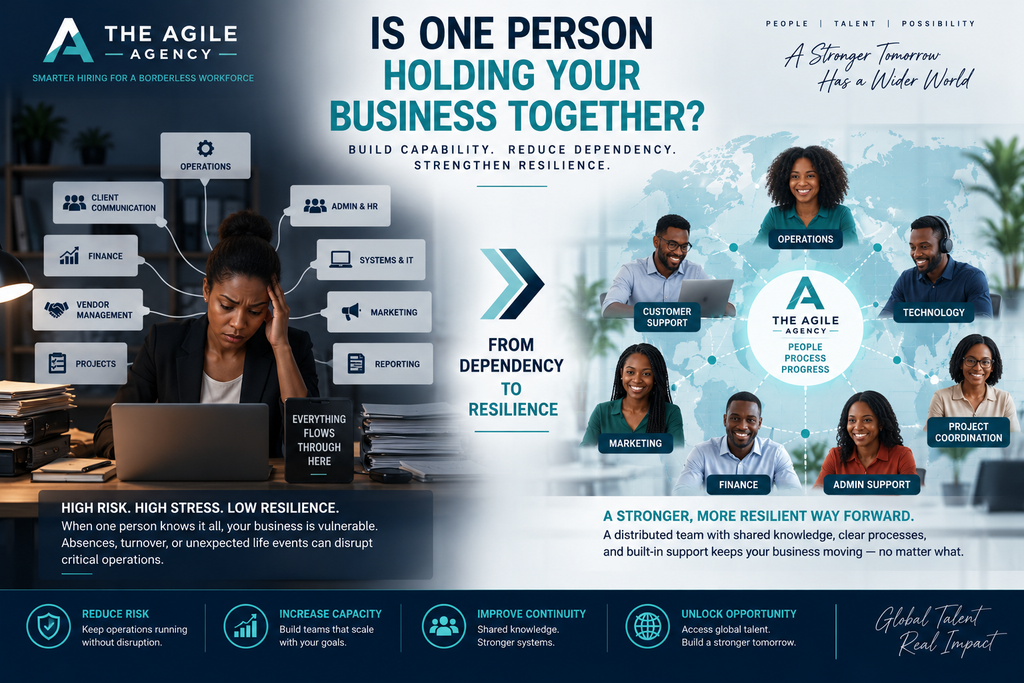
Projects aren’t being followed through.
Vendors aren’t being managed consistently.
Deadlines are slipping.
Departments aren’t coordinating effectively.
The founder isn’t primarily suffering from an administrative problem.
They may have an operations problem.
Hiring an excellent executive assistant against the wrong problem can still produce a disappointing result.
Not because the employee failed.
Because the role was incorrectly designed from the beginning.
The Job Description Trap
Traditional job descriptions frequently become collections of everything leadership would like someone else to do.
You’ll see roles containing:
- Administrative support
- Social media
- Customer service
- Project management
- Bookkeeping
- Sales support
- Research
- Vendor management
all under one title.
The company thinks it has created an efficient position.
In reality, it may have combined several unrelated business problems into one job.
That creates ambiguity.
And ambiguity eventually creates:
- Competing priorities
- Poor accountability
- Inconsistent performance
- Employee frustration
- Leadership disappointment
When everything is important, nothing is truly owned.
Start With the Constraint
A better hiring process begins with diagnosis.
Ask:
What is preventing the business from performing better today?
Maybe leads are arriving but nobody follows up consistently.
That’s a sales-capacity problem.
Maybe customers wait too long for responses.
That’s a customer-support capacity problem.
Maybe the founder spends 20 hours each week coordinating projects.
That’s an operational leverage problem.
Maybe financial information is constantly late.
That’s a finance capability problem.
Maybe product development keeps slowing because technical work is backlogged.
That’s a technology capacity problem.
Once the constraint becomes clear, the role becomes easier to design.
One Hire Should Have a Primary Mission
Every position should be explainable in one sentence.
Not:
“They help with a little bit of everything.”
Instead:
“This person ensures every qualified lead receives timely and consistent follow-up.”
Or:
“This person owns day-to-day project coordination so deadlines and responsibilities remain visible.”
Or:
“This person removes recurring administrative work from the founder so leadership capacity can be redirected toward growth.”
Or:
“This person maintains accurate financial records so leadership has reliable information for decision-making.”
That’s a mission.
And a mission creates clarity.
Hire for Outcomes, Not Activity
Once the business problem is defined, determine what should change after the hire.
Suppose a company needs customer support.
A task-based job description might say:
- Answer emails
- Respond to customer questions
- Update tickets
- Escalate complaints
An outcome-based role might instead define success as:
- Customer inquiries acknowledged within the agreed service standard
- Issues accurately categorized and tracked
- Escalations routed appropriately
- Recurring customer problems identified and reported
- Customer records consistently maintained
The tasks still exist.
But now they serve an outcome.
That makes performance significantly easier to evaluate.
The 90-Day Test
Before opening a position, ask:
If this hire is successful, what will be measurably better 90 days after they start?
If leadership cannot answer that question, the role probably isn’t ready to recruit.
A successful hire might mean:
Founder administrative workload reduced by 50%.
Customer response times reduced from 24 hours to four.
Every active project has an owner, deadline, and documented status.
Monthly reporting is completed accurately by a defined date.
Technical backlog has been reduced by a specified amount.
These outcomes give both the company and employee something concrete to work toward.
The Right Title Usually Becomes Obvious Later
Once you’ve defined:
- The business problem
- The desired outcome
- The core responsibilities
- The required competencies
- The level of autonomy
then ask:
What kind of professional is best equipped to own this?
Now the title serves the role.
The role doesn’t serve the title.
This also prevents companies from hiring according to assumptions.
Sometimes the role you thought you needed isn’t the role your business actually needs.
This Matters Even More in Global Hiring
Global hiring dramatically expands the available talent pool.
That’s an advantage.
But access to more candidates doesn’t fix a poorly designed position.
If a company cannot clearly explain what it needs accomplished, recruiting internationally simply gives it more people to evaluate against an unclear objective.
The strongest global hiring strategy begins before sourcing.
It begins with workforce design.
What capability is missing?
What problem needs ownership?
What outcome should improve?
What level of experience is necessary?
Only then should the search begin.
Don’t Hire Seniority You Don’t Need
Problem-first hiring can also prevent another expensive mistake:
over-hiring.
Companies sometimes assume a difficult problem requires a senior employee.
Not necessarily.
If the process is already well-defined and the role primarily requires consistent execution, an associate or professional-level employee may be entirely appropriate.
Conversely, a highly ambiguous role requiring independent judgment, process design, and complex problem-solving may require greater experience.
The level should follow the complexity of the problem.
Not prestige.
Don’t Under-Hire Complexity Either
The opposite mistake is equally dangerous.
Businesses sometimes try to save money by assigning sophisticated responsibilities to someone without the experience or authority required to manage them.
Then leadership becomes frustrated because the employee constantly needs direction.
Again, the problem may not be the person.
The role and capability requirements were mismatched.
Before hiring, determine whether the position primarily requires:
Execution: Follow an established process accurately.
Coordination: Manage moving pieces across people and deadlines.
Analysis: Interpret information and recommend actions.
Creation: Build something that does not yet exist.
Decision-making: Exercise judgment with meaningful business consequences.
The greater the complexity and autonomy required, the more carefully experience must be calibrated.
The Hidden Benefit: Better Interviews
Problem-first hiring improves interviewing too.
Instead of asking generic questions such as:
“Tell me about yourself.”
leadership can evaluate whether candidates have actually solved similar problems.
Ask:
“Tell me about a time you inherited a project with unclear ownership. How did you organize it?”
Or:
“A customer has contacted the company three times without resolution. Walk me through what you would do.”
Or:
“You discover a recurring process takes four hours every week. How would you determine whether it could be improved?”
Now the interview tests capability against the actual business need.
It Also Improves Onboarding
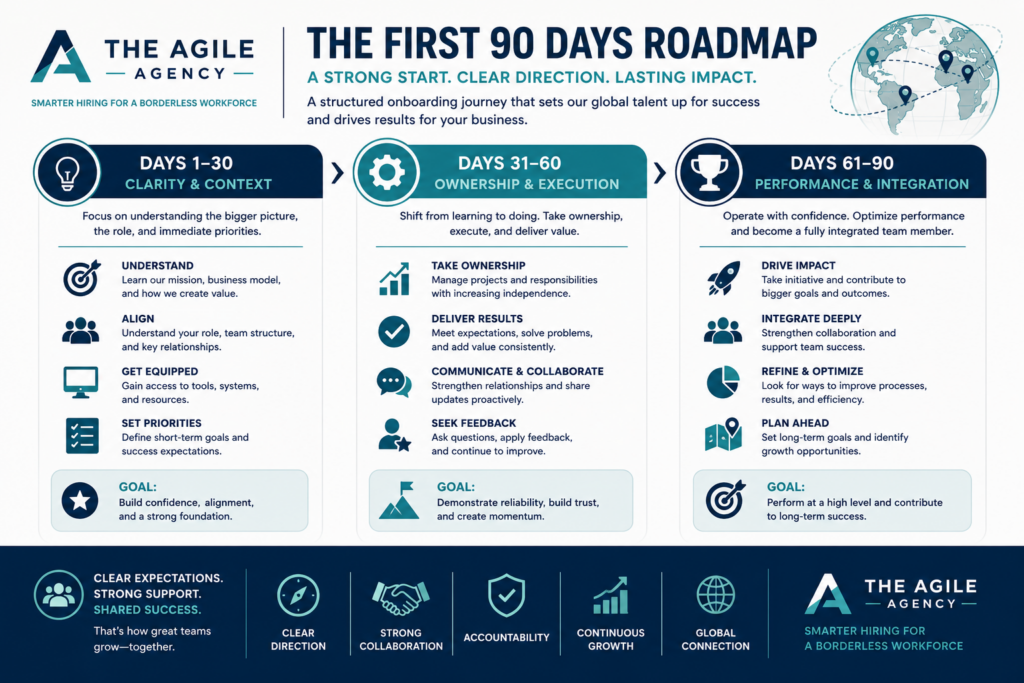
A clearly designed role makes the first 90 days much easier.
The new employee knows:
- Why they were hired
- What they own
- Which problem they’re expected to solve
- How their work connects to the business
- How success will be evaluated
Compare that with:
“Here’s a list of things we need help with.”
One creates ownership.
The other creates dependency on constant instructions.
The Workforce Architecture Question
As businesses grow, leadership should periodically stop thinking in terms of individual vacancies and examine the entire organization.
Ask:
What capabilities must this business possess to execute its strategy?
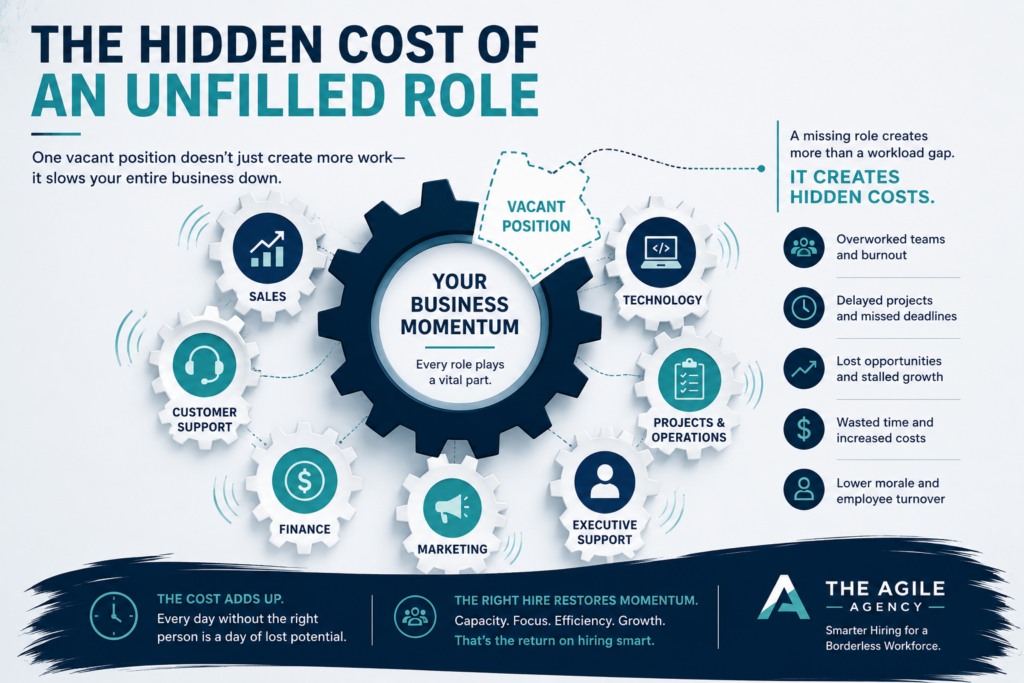
Perhaps the answer includes:
- Customer support
- Financial control
- Technology
- Operations
- Marketing
- Data analysis
- Project coordination
- Executive support
Then examine where those capabilities currently live.
Are they appropriately staffed?
Are responsibilities duplicated?
Are important functions missing?
Are senior employees doing work that should be delegated?
Are people carrying unrelated responsibilities because the organization grew around them rather than by design?
This is how workforce planning becomes strategic.
Your Organizational Chart Should Follow Your Strategy
Many businesses inherit their organizational structure accidentally.
A founder hires someone.
That person becomes good at something.
More responsibilities accumulate.
Another employee is added.
A new client creates another need.
Three years later, the organization chart reflects a sequence of historical decisions rather than the company’s current strategy.
Growth eventually requires redesign.
Your workforce should reflect:
where the company is going, not merely how it got here.
That may mean redefining roles.
Separating responsibilities.
Creating new capabilities.
Eliminating duplication.
Or recruiting expertise the organization never previously needed.
The Global Workforce Opportunity
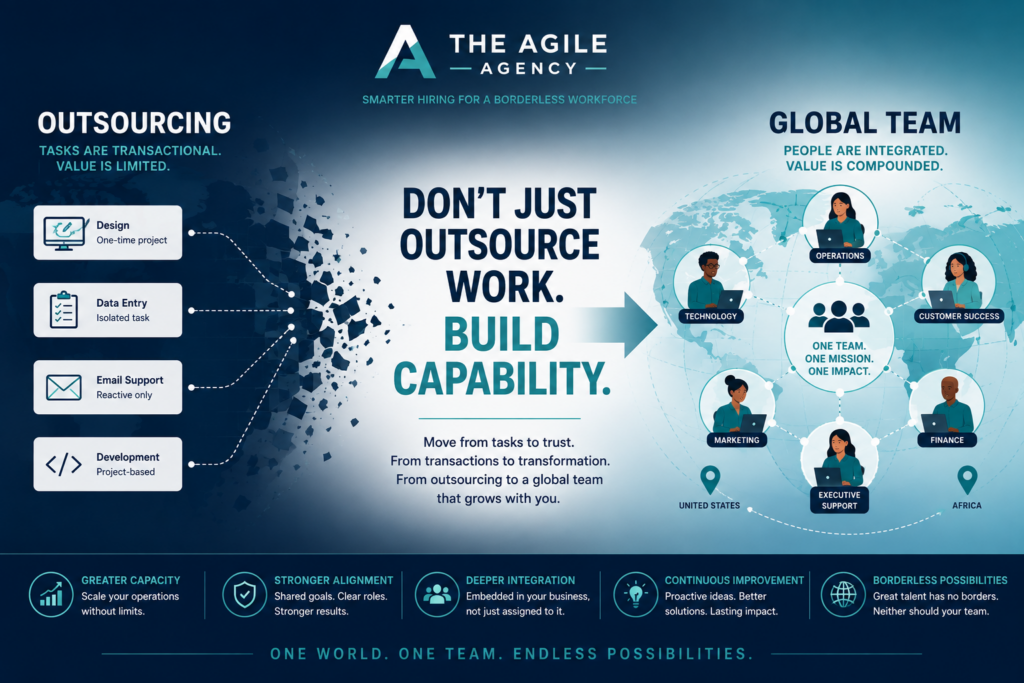
This is where borderless hiring becomes strategically powerful.
When geography is no longer the primary constraint, businesses can think more precisely about the capabilities they need.
Instead of asking:
“Who can we find near our office?”
leadership can ask:
“What expertise does the business require, and where can we find the right professional to provide it?”
That expands the possibilities considerably.
For growing companies, it can mean accessing specialized capability earlier than traditional local hiring economics might otherwise allow.
But the advantage begins with clarity.
Global talent cannot solve a problem leadership hasn’t defined.
A Better Pre-Hiring Framework
Before approving your next position, answer these six questions:
1. What business problem are we solving?
Be specific.
2. What happens if we do nothing?
Define the cost of leaving the problem unresolved.
3. What outcome should this employee own?
Identify the result—not merely the activity.
4. What should be measurably better within 90 days?
Create an early performance benchmark.
5. What level of judgment and autonomy does the role require?
Match experience to complexity.
6. What professional profile is best suited to deliver that outcome?
Only now should the job title become important.
Final Thought
Companies don’t actually need job titles.
They need capabilities.
They need problems solved.
They need outcomes delivered.
They need customers supported.
They need projects completed.
They need systems maintained.
They need leaders freed to lead.
Job titles are simply the organizational language we use to assign ownership to those needs.
So before your next hiring conversation begins with:
“We need a ______.”
Stop.
Ask:
“What needs to become better in this business?”
Then build the role around the answer.
Because better hiring doesn’t begin with finding the right candidate.
It begins with defining the right problem.
For Founders and Business Leaders
Take the position you’re planning to hire next and temporarily delete the job title.
Write down only:
The problem.
The outcome.
The required capability.
The 90-day definition of success.
Then ask yourself:
Would I still design the same role?
If the answer is no, you’ve just discovered why workforce strategy needs to happen before recruiting.
About The Agile Agency
The Agile Agency connects U.S. businesses with vetted African professionals across software engineering, IT and systems support, and education.
We believe strong hiring begins with understanding what a business actually needs – not simply filling an empty seat.
Smarter Hiring for a Borderless Workforce.