Category: Uncategorized

  • The Salary Is Not the Cost: How Smart Companies Calculate the True ROI of a Hire

    The Salary Is Not the Cost: How Smart Companies Calculate the True ROI of a Hire

    When business owners evaluate a new hire, one number tends to dominate the conversation:

    Salary.

    Can we afford $60,000?

    Can we afford $80,000?

    Could we find someone for less?

    These are reasonable questions.

    But salary alone tells you surprisingly little about whether a hiring decision makes financial sense.

    A $40,000 employee can be extraordinarily expensive if the role produces little value.

    A $100,000 employee can be remarkably inexpensive if that person creates several times their compensation in additional revenue, capacity, efficiency, or risk reduction.

    The better question isn’t:

    “How much does this person cost?”

    It’s:

    “What economic value should this role create for the business?”

    That shift – from salary thinking to return-on-talent thinking – can fundamentally change the way a company builds its workforce.


    Every Hire Is a Capital Allocation Decision

    Business owners routinely evaluate investments.

    If you’re purchasing equipment, you consider whether the investment will increase production.

    If you’re spending on marketing, you consider customer acquisition and revenue.

    If you’re implementing new technology, you consider the efficiency it may create.

    Hiring deserves the same discipline.

    Every new position represents capital being deployed with an expected return.

    That return may appear as:

    • Additional revenue
    • Greater operational capacity
    • Lower costs
    • Faster execution
    • Better customer retention
    • Reduced risk
    • Leadership time recovered

    Not every role generates revenue directly.

    But every well-designed role should create measurable economic value somewhere in the organization.


    The $30,000 Employee Who Costs $70,000

    Imagine a company hires someone because the candidate is inexpensive.

    The salary looks attractive.

    But the employee requires constant supervision.

    Work must regularly be corrected.

    Deadlines are missed.

    Customers become frustrated.

    Other employees spend time compensating for mistakes.

    Eventually, leadership replaces the person.

    The original salary was never the true cost.

    The business also paid for:

    • Recruitment
    • Onboarding
    • Training
    • Management time
    • Rework
    • Lost productivity
    • Potential customer dissatisfaction
    • Another recruitment cycle

    A low salary does not automatically mean a low-cost hire.

    Sometimes it means precisely the opposite.


    The More Expensive Candidate May Be the Better Investment

    Now consider another candidate.

    Their compensation is higher.

    But they:

    • Require less supervision
    • Solve problems independently
    • Improve processes
    • Produce higher-quality work
    • Communicate proactively
    • Prevent mistakes
    • Create additional capacity for management

    The payroll number is larger.

    The economic cost may actually be lower.

    This is why comparing candidates primarily on compensation can produce poor decisions.

    Price and value are not the same thing.


    Calculate the Cost of the Problem First

    Before deciding what you can afford to pay someone, calculate what the problem you’re hiring them to solve is already costing you.

    Suppose a founder spends 15 hours every week on administrative and operational work.

    That’s roughly 60 hours per month.

    If those 60 hours could instead be spent on:

    • Business development
    • Strategic partnerships
    • Sales
    • Product development
    • Client relationships

    what could those hours potentially produce?

    Suddenly, the economics of hiring administrative or executive support look very different.

    The employee isn’t merely adding payroll.

    They’re buying back founder capacity.

    That capacity has value.


    Five Ways Employees Create Economic Value

    Not every employee should be measured against direct sales.

    A more sophisticated workforce strategy recognizes several forms of return.

    1. Revenue Creation

    Some roles have an obvious relationship to revenue.

    Sales professionals.

    Business development representatives.

    Account managers.

    Marketing professionals.

    Their performance may contribute directly or indirectly to new business.

    For these roles, companies can evaluate metrics such as:

    • Pipeline generated
    • Conversion rates
    • Revenue influenced
    • Customer acquisition

    But revenue is only one form of return.


    2. Capacity Creation

    An employee may allow someone else in the organization to operate at a higher level.

    This is particularly important for founders and senior leaders.

    An effective executive assistant may not generate a single dollar of revenue directly.

    But if that person returns 10 or 15 hours of executive capacity every week, the economic value can be substantial.

    The question becomes:

    What can the executive accomplish with the time that has been returned?


    3. Efficiency Creation

    Some hires improve how work gets done.

    A strong operations professional might:

    • Eliminate unnecessary steps
    • Automate repetitive processes
    • Improve workflows
    • Reduce turnaround times
    • Standardize procedures

    If a process that previously required 20 hours now requires 10, the employee has created measurable economic value.


    4. Risk Reduction

    Certain roles protect the organization.

    Finance professionals may improve reporting accuracy.

    IT professionals may strengthen cybersecurity.

    Quality specialists may reduce defects.

    Customer support professionals may prevent client attrition.

    The return isn’t always visible as new revenue.

    Sometimes the return is the loss that never occurred.

    That still has economic value.


    5. Opportunity Creation

    Perhaps the most overlooked form of talent ROI is what becomes possible because the right person joined the organization.

    A new hire might allow a company to:

    • Enter a new market
    • Serve more customers
    • Launch a new product
    • Extend service hours
    • Take on larger contracts
    • Improve customer experience
    • Pursue opportunities leadership previously lacked capacity to address

    This is where talent moves beyond expense and becomes infrastructure for growth.


    Where Global Hiring Changes the Economics

    This is where global workforce strategy becomes particularly interesting.

    Historically, many small and midsize businesses delayed building specialized teams because domestic payroll economics made those roles difficult to justify.

    The business might need:

    • A software professional
    • An accountant
    • An executive assistant
    • A customer support specialist
    • A marketing coordinator
    • A research analyst

    But it might not yet have the economics to build that entire team locally.

    Global hiring can change that equation.

    The advantage isn’t simply:

    “We found cheaper employees.”

    The more strategic advantage is:

    “We can build capabilities earlier.”

    That distinction matters.


    Earlier Capability Can Produce Earlier Growth

    Imagine two competing businesses.

    Both need additional operational capacity.

    Company A waits another 18 months because it cannot justify the domestic payroll required to build its team.

    Company B strategically hires qualified global professionals and builds that capacity now.

    Over those 18 months, Company B may be able to:

    • Respond to customers faster
    • Execute more projects
    • Develop new services
    • Improve internal systems
    • Pursue additional sales
    • Give leadership more strategic bandwidth

    By the time Company A finally hires, Company B may already be significantly ahead.

    The advantage wasn’t merely lower payroll.

    It was time.

    And time can be one of the most valuable forms of competitive advantage.


    But Global Hiring Should Never Become a Race to the Bottom

    There is an important caution here.

    If businesses view global hiring exclusively as a mechanism for finding the lowest possible salary, they can recreate the same flawed decision-making process on an international scale.

    The objective should not be:

    Find the cheapest person available.

    It should be:

    Find qualified talent at an economically sustainable compensation structure that creates value for both the company and the professional.

    Cost efficiency and quality are not mutually exclusive.

    But cost efficiency without quality is simply false economy.


    Build a Business Case Before Opening the Position

    Before hiring, leadership should be able to answer several questions.

    What problem are we solving?

    Be specific.

    “We need help” isn’t a workforce strategy.

    What is the problem currently costing us?

    Consider time, revenue, delays, customer experience, management attention, and risk.

    What outcomes will this role own?

    Define results rather than creating a list of activities.

    What would success look like after six months?

    This creates a basis for evaluating performance.

    What happens financially if we don’t hire?

    This is often the missing calculation.

    Doing nothing also has a cost.


    Stop Asking Whether You Can Afford the Employee

    This may be the biggest mindset shift.

    When considering a strategically important role, the question shouldn’t automatically be:

    “Can we afford to hire this person?”

    Sometimes the more useful question is:

    “Can we afford to continue operating without this capability?”

    Those questions can lead to very different conclusions.

    A growing business may discover that the greater financial risk isn’t adding payroll.

    It’s allowing:

    • Founder bottlenecks to continue
    • Leads to remain untouched
    • Customers to wait
    • Projects to stall
    • Opportunities to pass
    • High-value employees to spend time on low-value work

    Payroll is visible.

    Opportunity cost usually isn’t.

    That doesn’t make it less real.


    The Talent ROI Scorecard

    Before approving your next position, evaluate the role across five dimensions:

    Revenue: What revenue could this role create, influence, or protect?

    Capacity: Whose time will this employee free—and what is that time worth?

    Efficiency: What processes could become faster or less expensive?

    Risk: What mistakes, losses, or disruptions could this role help prevent?

    Opportunity: What can the business pursue once this capability exists?

    You may discover that the most important number in the hiring decision isn’t the employee’s salary.

    It’s the economic value surrounding the role.


    Final Thought

    People frequently appear on financial statements as expenses.

    Strategically, that is an incomplete way to think about talent.

    The right employee can be:

    Capacity.
    Infrastructure.
    Risk protection.
    Institutional knowledge.
    And a catalyst for growth.

    The goal isn’t to build the cheapest workforce.

    Nor is it to spend indiscriminately in the name of growth.

    The goal is to build a workforce where the value created by talent exceeds the capital required to employ it.

    That’s not simply hiring.

    That’s capital allocation through people.

    And businesses that learn to evaluate talent that way will make fundamentally better workforce decisions.


    For Founders and Business Leaders

    Before your next hiring decision, don’t begin with:

    “What’s the salary?”

    Begin with:

    “What business problem are we solving – and what is that problem worth?”

    Then determine what combination of talent, structure, and investment gives your company the strongest return.

    Because the cheapest hire isn’t necessarily the most affordable.

    And the most expensive hire isn’t necessarily the most costly.

    The number that matters is the value created after the person joins your team.


    About The Agile Agency

    The Agile Agency connects U.S. businesses with vetted African professionals across technology, education, customer support, executive and administrative support, operations, project management, finance, accounting, marketing, content, data, research, and analytics.

    Smarter Hiring for a Borderless Workforce.
  • Beyond Outsourcing: Why the Future Belongs to Companies That Build Global Teams

    For years, businesses approached international talent with a relatively simple objective:

    Find someone overseas to complete a task for less.

    Need graphic design? Outsource it.

    Need administrative support? Hire a virtual assistant.

    Need software development? Send the project offshore.

    That model helped introduce thousands of businesses to the possibilities of a global workforce.

    But it also created a misconception that still influences hiring decisions today:

    Global talent is primarily a source of outsourced labor.

    It isn’t.

    As businesses become increasingly distributed, the greater opportunity is not outsourcing more tasks.

    It is building integrated global teams.

    And the distinction matters.


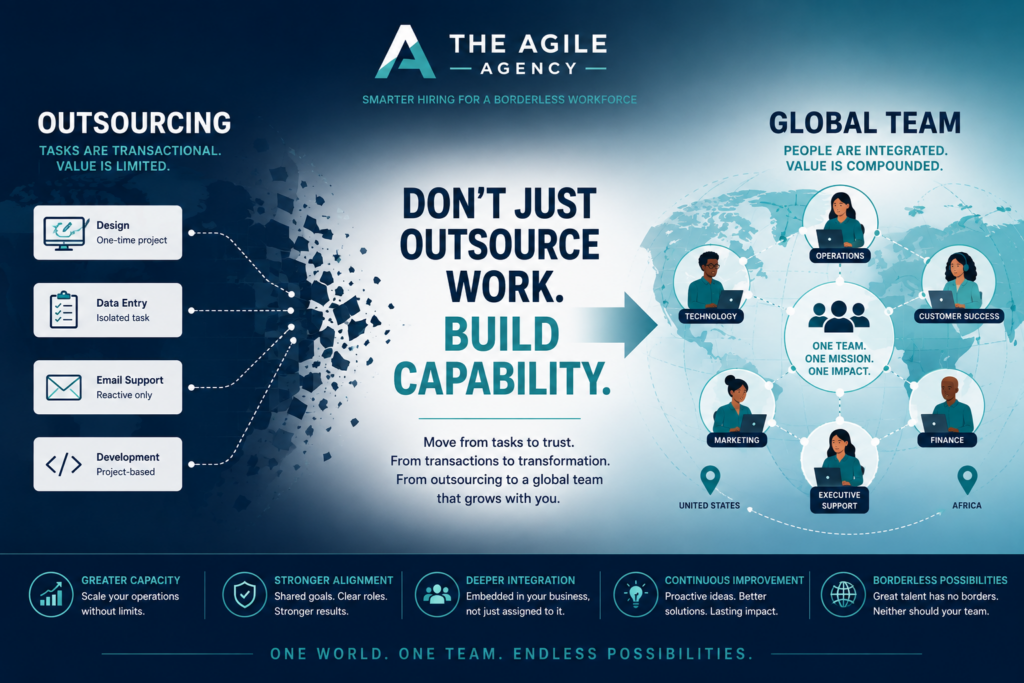
    Outsourcing Solves a Task. Team Building Solves a Capacity Problem.

    Traditional outsourcing is usually transactional.

    A company has a need.

    Someone completes the work.

    The engagement may end when the project ends.

    There is nothing inherently wrong with that model. For specialized or temporary projects, it can be extremely effective.

    But businesses often attempt to use the same model for work that is actually ongoing and operational.

    That is where problems begin.

    Customer relationships need continuity.

    Operations require institutional knowledge.

    Executive support becomes stronger as someone learns how leadership works.

    Marketing improves when the person executing it understands the company’s voice, audience, and strategy.

    These aren’t simply tasks.

    They are business functions.

    And business functions benefit from people who become part of the organization rather than remaining permanently outside it.


    The Difference Between a Vendor and a Team Member

    Consider two professionals performing similar work.

    One receives individual assignments with limited context.

    The other understands:

    • The company’s objectives
    • The customers it serves
    • How their role contributes to growth
    • Who owns adjacent responsibilities
    • What success looks like
    • Which priorities matter most

    Both may be talented.

    But their ability to contribute strategically will be very different.

    The second professional can eventually anticipate needs instead of simply responding to requests.

    That is where global hiring begins creating significantly more value.


    Institutional Knowledge Is an Asset

    One of the least discussed advantages of employee retention is accumulated knowledge.

    Over time, a strong employee learns things that rarely appear in an SOP.

    They understand why a particular client prefers a certain approach.

    They remember why a process was changed six months ago.

    They recognize patterns.

    They know which problems require escalation and which ones they can solve independently.

    They understand the founder’s priorities.

    That knowledge compounds.

    Constantly rotating contractors and freelancers can mean constantly rebuilding it.

    Businesses should consider institutional knowledge an asset—and design their workforce accordingly.


    Integration Changes Performance

    If companies want global professionals to perform like members of the team, they must integrate them like members of the team.

    That means giving them more than assignments.

    It means giving them context.

    Strong global teams need:

    Clear Roles

    Employees should understand what they own, where their authority begins and ends, and how performance will be evaluated.

    Access to Information

    People cannot make good decisions without context.

    Relevant company information should not remain unnecessarily concentrated with leadership.

    Communication Infrastructure

    Global professionals need to know how, when, and where the organization communicates.

    Professional Development

    If someone is expected to grow with the company, the company should also invest in their growth.

    A Path to Greater Responsibility

    High performers should be able to earn greater autonomy and responsibility over time.

    That’s how a hire becomes an organizational asset.


    Global Talent Should Not Mean Second-Class Talent

    There is another mindset companies must leave behind.

    If an employee happens to live in another country, that should not mean they receive less respect, less communication, less development, or less consideration than domestic colleagues.

    Geography changes where someone works.

    It should not determine whether their contribution matters.

    If companies recruit internationally solely because they believe workers in another country will tolerate poor management for lower compensation, they may fill positions.

    But they will struggle to build exceptional teams.

    High-performing professionals have options.

    The best global employers will understand that.


    The Managerial Standard Must Rise

    Building an international team also places greater responsibility on leadership.

    Managers cannot rely on physical proximity to compensate for weak management practices.

    They must become better at:

    • Defining expectations
    • Documenting processes
    • Providing feedback
    • Delegating authority
    • Communicating asynchronously
    • Measuring outcomes
    • Building trust

    This is one of the unexpected benefits of global hiring.

    Done properly, it can force an organization to become more disciplined.

    Processes that previously lived inside someone’s head must be documented.

    Responsibilities must become clearer.

    Communication must become more deliberate.

    Performance expectations must become measurable.

    In other words:

    Building a global team can make the entire company operate better.


    The Africa Opportunity Is Bigger Than Labor Arbitrage

    This distinction is particularly important when discussing African talent.

    The conversation should not begin and end with wage differences.

    Across Africa, businesses can access educated, ambitious professionals working in technology, finance, education, customer support, administration, operations, marketing, analytics, and other disciplines.

    The strategic opportunity for U.S. businesses is not simply to ask:

    “How cheaply can this work be done?”

    A better question is:

    “What capabilities could we add to our organization if geography were no longer a constraint?”

    That question produces very different hiring decisions.

    It also creates healthier long-term partnerships between companies and the professionals they employ.


    Cost Savings Still Matter

    None of this means economics should be ignored.

    Cost efficiency remains one of the legitimate advantages of global hiring.

    For small and growing businesses especially, international hiring can make certain capabilities financially accessible much earlier than traditional domestic hiring.

    But there is an important difference between:

    using global talent because it costs less

    and

    using the cost advantage of global talent to build a stronger company.

    The first is labor arbitrage.

    The second is workforce strategy.


    From Remote Worker to Trusted Operator

    The real return on a successful global hire often appears over time.

    At first, an employee may need detailed instructions.

    Then they learn the role.

    Then they learn the business.

    Eventually, the strongest employees begin identifying problems before leadership notices them.

    They recommend improvements.

    They take ownership.

    They become trusted operators.

    That progression is difficult to achieve when every relationship is treated as temporary.

    Businesses that want loyalty, initiative, and institutional knowledge must create conditions where those qualities can develop.


    What Founders Should Ask Before Hiring Globally

    Before filling your next international role, consider the purpose of the position.

    Is this genuinely a temporary project?

    If so, outsourcing may be exactly the right solution.

    But if the person will perform an ongoing business function, ask a different set of questions:

    • How will this person become integrated into our organization?
    • What information will they need to make good decisions?
    • What outcomes will they own?
    • How will we develop their capabilities?
    • What could this role become in 12 or 24 months?
    • Are we hiring someone to complete tasks—or someone who can eventually help us build?

    That final question may be the most important.


    The Strategic Shift

    The first era of global work was largely about outsourcing.

    The next era will increasingly be about integration.

    Companies will build teams that happen to span countries rather than treating international professionals as a separate category of labor.

    And eventually, the distinction between “remote employee” and “employee” may matter far less than it does today.

    The companies preparing for that future now will have an advantage.

    They will have learned how to recruit globally.

    How to manage globally.

    How to build culture globally.

    And, most importantly, how to turn geographic diversity into organizational strength.


    Final Thought

    Global hiring should not be about finding the cheapest person capable of completing a task.

    It should be about removing geography from the question of where great talent can come from.

    There will always be a place for freelancers, contractors, and outsourced projects.

    But when a business needs sustained capability, institutional knowledge, accountability, and long-term growth, it needs something more.

    It needs a team.

    And increasingly, the strongest team available to a growing business may not exist within commuting distance of its headquarters.

    It may exist across borders.

    The future of work isn’t simply remote.

    It’s global.

    And the businesses that understand the difference between outsourcing work and building a global workforce will be positioned to capture far more of its potential.


    About The Agile Agency

    The Agile Agency helps U.S. businesses access vetted African professionals across technology, education, and analytics.

    Smarter Hiring for a Borderless Workforce.
  • The 90-Day Rule: Why the First Three Months Determine the Success of Every New Hire

    Hiring the right person is only half the battle.

    What happens after they accept the offer often determines whether they become one of your strongest contributors – or one of your biggest disappointments.

    Many organizations invest heavily in recruiting, interviewing and negotiating offers, only to leave new employees to “figure things out” once they join the team.

    The first 90 days are not simply an adjustment period.

    They are the foundation for long-term performance, engagement and retention.

    Whether you’re hiring locally or building a global remote workforce, the onboarding experience has a lasting impact on how quickly new employees become productive and how long they stay with your organization.


    Why the First 90 Days Matter

    Every new employee arrives with three questions, whether they say them out loud or not:

    • What is expected of me?
    • How will I know if I’m succeeding?
    • Where do I fit within this organization?

    When companies answer these questions early, employees gain confidence.

    When they don’t, uncertainty fills the gap.

    Uncertainty leads to hesitation.

    Hesitation slows productivity.

    The first three months should eliminate uncertainty—not create it.


    Month One: Build Clarity

    The first 30 days should focus on understanding, not volume.

    Too many organizations overwhelm new employees with endless documentation, meetings and systems without providing context.

    Instead, prioritize clarity.

    A successful first month should help employees understand:

    • The company’s mission and values
    • Their role and responsibilities
    • Key workflows and processes
    • Communication expectations
    • Performance metrics
    • The people they will collaborate with most often

    This creates confidence and reduces avoidable mistakes.


    Month Two: Build Competence

    Once employees understand their role, the next step is developing capability.

    The second month should focus on:

    • Increasing ownership
    • Expanding responsibilities
    • Strengthening technical skills
    • Encouraging independent decision-making

    Managers should continue providing regular feedback while gradually reducing day-to-day oversight.

    The goal is not perfection.

    The goal is steady progress.


    Month Three: Build Ownership

    By the third month, employees should begin thinking beyond completing tasks.

    They should understand how their work contributes to larger business objectives.

    This is the stage where leaders should encourage:

    • Process improvement ideas
    • Greater initiative
    • Cross-functional collaboration
    • Long-term goal setting

    Employees who develop a sense of ownership are more likely to remain engaged and contribute beyond their job descriptions.


    Why Remote Employees Need Even More Structure

    Remote professionals don’t benefit from informal learning opportunities that naturally occur in an office.

    They can’t overhear conversations.

    They can’t quickly stop by a manager’s desk.

    Every expectation must be intentionally communicated.

    Successful remote onboarding includes:

    • Documented processes
    • Weekly one-on-one meetings
    • Clear response-time expectations
    • Access to training resources
    • Regular performance discussions

    Structure creates confidence.

    Confidence creates performance.


    Common Onboarding Mistakes

    Even organizations with strong hiring processes can undermine new employees by making avoidable onboarding mistakes.

    Some of the most common include:

    Information Overload

    Trying to teach everything in the first week often results in employees remembering very little.

    Inconsistent Communication

    When expectations change daily or differ between managers, employees become confused.

    Lack of Early Feedback

    Employees shouldn’t have to wait until a 90-day review to learn whether they’re meeting expectations.

    No Defined Success Metrics

    Without measurable goals, employees are left guessing what success looks like.


    Measuring Success During the First 90 Days

    Instead of relying solely on subjective impressions, establish measurable indicators of progress.

    Examples include:

    • Completion of onboarding milestones
    • Accuracy of assigned work
    • Project turnaround times
    • Communication responsiveness
    • Ability to work independently
    • Team collaboration

    These metrics provide objective insight into whether onboarding is working.


    The Agile Agency Approach

    At The Agile Agency, we believe successful hiring doesn’t end when a candidate accepts an offer.

    It begins there.

    That’s why we encourage clients to build structured onboarding systems alongside structured hiring processes.

    We help organizations define:

    • Clear performance expectations
    • Role scorecards
    • Communication frameworks
    • Workflow documentation
    • Success milestones for the first 90 days

    This approach helps new hires become productive faster while reducing turnover and improving long-term performance.


    Great Teams Aren’t Built in a Day

    Exceptional employees rarely become exceptional overnight.

    They become exceptional because they are given clarity, support and opportunities to grow.

    Organizations that invest intentionally in the first 90 days don’t just onboard employees.

    They build future leaders.

    The businesses that consistently outperform their competitors understand that hiring isn’t the finish line.

    It’s the starting point.


    Final Thoughts

    Your recruitment process gets people through the door.

    Your onboarding process determines whether they stay, grow and succeed.

    If you’re investing time and resources to find exceptional talent, don’t leave their success to chance.

    Create a structured first 90 days.

    Because the quality of your onboarding often becomes the quality of your workforce.


    Building a high-performing team requires more than finding great talent – it requires setting them up for success.

    At The Agile Agency, we help businesses not only identify exceptional global professionals but also build onboarding systems that accelerate productivity, strengthen engagement and support long-term growth.

    If you’re ready to build a workforce that thrives from day one, let’s start the conversation.

  • Why Great Hires Still Fail: The First 90 Days Matter More Than Most Companies Realize

    Hiring the right person is only half the work.

    The other half begins after the offer is accepted.

    Many companies invest significant time identifying, interviewing, and selecting strong candidates, only to lose momentum during onboarding. The new hire arrives ready to contribute, but the organization is not prepared to integrate them effectively.

    There is no structured introduction.

    Expectations are unclear.

    Access to systems is delayed.

    Managers assume the employee will “figure things out.”

    Then, within a few weeks, frustration begins on both sides.

    The company starts questioning the hire.

    The employee starts questioning the company.

    What appears to be a performance problem is often an onboarding problem.

    For remote and global teams, the first 90 days are especially important. Distance removes many of the informal learning opportunities that exist in a traditional office, which means companies must replace them with deliberate structure.

    Onboarding Is Not an Orientation Call

    Many businesses confuse onboarding with administration.

    They send an employment agreement.

    They create an email address.

    They schedule an introductory meeting.

    They share a few documents.

    Then they expect productivity to begin.

    Those steps are necessary, but they do not constitute a complete onboarding process.

    Effective onboarding should help a new employee understand:

    • Why the company exists
    • How the business operates
    • What their role is responsible for
    • What success looks like
    • How decisions are made
    • Who they should communicate with
    • What they are expected to accomplish first

    Without that clarity, even highly capable professionals can struggle.

    Why Remote Employees Need More Structure

    In a physical office, a new employee can observe how people work.

    They can listen to conversations.

    They can ask a colleague a quick question.

    They can see how managers respond to challenges.

    Remote employees do not have the same access to context.

    They cannot absorb the company culture by walking through the workplace.

    They cannot easily tell which tasks are urgent, which processes are flexible, or which decisions require approval.

    As a result, remote onboarding must be more intentional than in-person onboarding.

    Not more complicated.

    More explicit.

    The Cost of Weak Onboarding

    Poor onboarding creates problems that extend far beyond the new hire.

    1. Slower Time to Productivity

    When employees lack the information, tools, or context they need, they take longer to become effective.

    Managers then spend more time correcting work, repeating instructions, and answering preventable questions.

    2. Reduced Confidence

    New employees want to make a strong impression.

    When expectations are unclear, they become hesitant.

    They may delay decisions, avoid taking initiative, or over-rely on management because they are unsure what authority they have.

    3. Early Disengagement

    Employees begin forming opinions about an organization immediately.

    A disorganized first week can signal that the company lacks structure, communication, or respect for their time.

    That impression can be difficult to reverse.

    4. Increased Turnover Risk

    Many early departures are not caused by compensation.

    They are caused by unmet expectations, poor communication, and the feeling that the employee was never properly set up to succeed.

    Replacing that employee means restarting the entire recruitment process.

    The First 90 Days Should Be Designed in Stages

    A strong onboarding process should not overwhelm the employee with everything at once.

    It should build competence progressively.

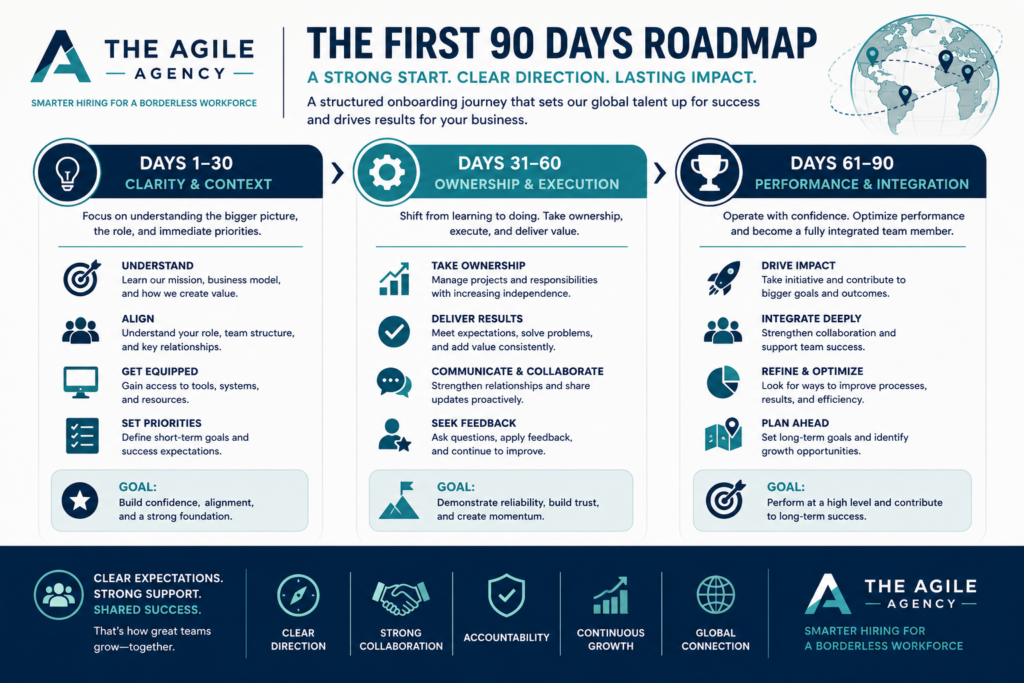
    Days 1–30: Clarity and Context

    The first month should focus on understanding.

    The employee needs to learn:

    • The company’s mission and business model
    • The purpose of their role
    • Core systems and tools
    • Communication expectations
    • Team structure
    • Immediate priorities
    • Quality standards

    This is also the period for establishing trust.

    Managers should create space for questions and explain not only what needs to be done, but why it matters.

    The goal of the first 30 days is not maximum output.

    It is alignment.

    Days 31–60: Ownership and Execution

    During the second month, the employee should begin taking greater responsibility.

    They should move from observation to consistent execution.

    At this stage, managers should evaluate:

    • Accuracy
    • Reliability
    • Communication
    • Follow-through
    • Problem-solving
    • Ability to apply feedback

    Responsibilities should expand gradually, with clear checkpoints along the way.

    The employee should understand where they can act independently and where approval is still required.

    The goal is controlled ownership.

    Days 61–90: Performance and Integration

    By the third month, the employee should be functioning as a fully contributing member of the team.

    They should understand their workflows, key relationships, reporting expectations, and performance standards.

    This is the time to assess:

    • Progress against role objectives
    • Strengths demonstrated
    • Areas requiring further development
    • Long-term fit
    • Additional training needs
    • Opportunities for expanded responsibility

    The 90-day review should not be the first serious performance conversation.

    It should be the culmination of regular feedback provided throughout the onboarding period.

    What Strong Onboarding Includes

    High-performing companies usually provide several essential components.

    A Clear Role Scorecard

    The employee should know exactly what outcomes they are responsible for producing.

    A strong scorecard may include:

    • Primary responsibilities
    • Weekly or monthly deliverables
    • Performance metrics
    • Quality expectations
    • Reporting relationships
    • Decision-making authority

    This eliminates ambiguity from the beginning.

    A Structured Training Plan

    Training should be sequenced.

    Employees should not receive a folder containing dozens of documents and be expected to determine what matters most.

    A better process includes:

    • Required reading in priority order
    • System demonstrations
    • Recorded training where appropriate
    • Practical assignments
    • Guided review of completed work
    • Clear milestones

    Immediate Access to Tools

    Technology delays create avoidable frustration.

    Before the employee starts, the company should prepare:

    • Email access
    • Project management tools
    • Communication platforms
    • Shared drives
    • Required software
    • Security protocols
    • Password management systems

    A new employee should not spend their first week waiting for access.

    Defined Communication Rhythms

    Remote employees need to know how communication works.

    That includes:

    • When meetings occur
    • Which platform is used for which purpose
    • How quickly messages should be answered
    • When issues should be escalated
    • How progress should be reported
    • Who makes final decisions

    Communication should not depend on guesswork.

    Early Feedback

    Managers often wait too long to correct small issues.

    By the time formal feedback is given, poor habits may already be established.

    Early feedback should be:

    • Specific
    • Timely
    • Constructive
    • Connected to clear expectations

    Employees generally adjust faster when they know exactly what needs to improve.

    Global Onboarding Requires Cultural Intelligence

    When hiring internationally, companies must also account for differences in communication, hierarchy, and workplace norms.

    For example, some employees may be less likely to challenge a manager directly.

    Others may interpret silence as approval.

    Some may wait for explicit instructions rather than act independently.

    These are not necessarily performance deficiencies.

    They may reflect different professional or cultural expectations.

    Strong global managers clarify:

    • Whether questions are encouraged
    • How disagreement should be expressed
    • What initiative looks like
    • When employees should make decisions independently
    • How feedback is delivered

    Cultural intelligence does not mean lowering standards.

    It means communicating those standards in a way that can be understood and applied consistently.

    Managers Must Own the Onboarding Process

    Onboarding cannot be delegated entirely to human resources or administrative staff.

    The direct manager plays the most important role.

    Managers are responsible for translating the role into daily execution.

    They must provide context, priorities, feedback, and accountability.

    When a manager is unavailable, inconsistent, or unclear, the employee’s development slows.

    A strong onboarding system supports the manager.

    It does not replace them.

    The Strategic Advantage of Better Onboarding

    Companies often focus heavily on improving recruitment.

    But better onboarding can create equally significant results.

    A well-integrated employee:

    • Reaches productivity faster
    • Makes fewer preventable mistakes
    • Communicates more confidently
    • Requires less corrective management
    • Builds stronger relationships
    • Is more likely to remain with the company

    This creates value long after the first 90 days.

    Strong onboarding transforms a successful hire into a productive, engaged, and dependable team member.

    Final Thought

    A great candidate does not automatically become a great employee.

    That transition depends on the environment the company creates around them.

    Hiring brings talent into the organization.

    Onboarding turns that talent into performance.

    For global and remote teams, the companies that succeed will not simply be the ones with access to the largest talent pools.

    They will be the ones that know how to integrate, develop, and retain the people they hire.

    For Founders and Business Leaders

    Before your next employee starts, ask:

    • Is their first week already planned?
    • Are their priorities clearly defined?
    • Will every required system be ready?
    • Do they know how success will be measured?
    • Is there a structured plan for their first 30, 60, and 90 days?

    If the answer is no, the risk is not only that the employee may struggle.

    The greater risk is that your company may misjudge a strong hire because it never gave them a fair opportunity to succeed.

    The first 90 days are not an administrative period.

    They are the foundation of the employee’s future performance.

  • Hiring for Potential vs. Hiring for Experience: Which Builds Stronger Teams?

    Every hiring manager eventually faces the same question:

    Should we hire the person with the most experience, or the person with the greatest potential?

    It’s tempting to assume that years of experience automatically translate into stronger performance. After all, experience offers proof that someone has done the job before.

    But experience alone doesn’t always predict future success.

    In today’s rapidly changing business environment, organizations need employees who can adapt, learn, and grow – not just repeat what they’ve done in the past.

    The strongest teams aren’t built by choosing one over the other.

    They’re built by knowing when experience matters most and when potential creates greater long-term value.


    Experience Is Valuable – But It Isn’t Everything

    Experience reduces uncertainty.

    Someone who has successfully performed a role before often requires less training and can contribute more quickly.

    Experienced professionals typically bring:

    • Industry knowledge
    • Technical expertise
    • Established best practices
    • Confidence in decision-making
    • Familiarity with complex situations

    For highly specialized or regulated positions, experience is often essential.

    However, relying exclusively on experience can create unintended limitations.


    Experience Can Sometimes Create Rigidity

    One challenge with hiring solely for experience is that previous success can shape future thinking.

    Professionals who have worked within one organization or industry for many years may naturally default to familiar processes—even when new approaches would be more effective.

    Innovation often requires curiosity.

    Curiosity isn’t measured by years on a résumé.

    It’s measured by a person’s willingness to ask questions, learn continuously and adapt.


    Potential Is an Investment

    Hiring for potential means evaluating who someone can become—not simply what they’ve already accomplished.

    Potential often reveals itself through qualities such as:

    • Curiosity
    • Coachability
    • Initiative
    • Problem-solving ability
    • Accountability
    • Adaptability

    These characteristics are difficult to teach.

    Technical skills, on the other hand, can often be developed through training and experience.

    When organizations invest in high-potential individuals, they’re investing in future leadership.


    Why This Matters in Global Hiring

    International hiring expands access to exceptional talent, but it also challenges traditional hiring assumptions.

    Many highly capable professionals outside major economic centers may not have worked for globally recognized companies.

    That doesn’t mean they lack capability.

    In many cases, they’ve developed remarkable resilience, resourcefulness and adaptability while working in environments with fewer resources.

    These professionals often bring fresh perspectives and a strong desire to grow.

    Looking only at company names on a résumé risks overlooking extraordinary talent.


    The Best Hiring Decisions Balance Both

    High-performing companies don’t ask:

    “Should we hire for experience or potential?”

    They ask:

    “What does this role require today, and what will it require tomorrow?”

    For example:

    A senior cybersecurity architect may require extensive experience.

    A project coordinator with strong organizational skills and exceptional communication may be an ideal candidate based on potential.

    The right hiring decision depends on the business objective – not a universal rule.


    How to Identify High-Potential Candidates

    Potential isn’t guesswork.

    It can be evaluated through structured interviews and practical assessments.

    Consider asking questions such as:

    • Tell me about a time you had to learn something completely new under pressure.
    • Describe a mistake that changed how you work today.
    • What’s the most challenging feedback you’ve received, and how did you respond?

    These conversations often reveal more about future performance than a list of previous job titles.


    Building Teams That Grow Together

    The strongest organizations aren’t built by collecting impressive résumés.

    They’re built by creating environments where capable people continue learning.

    This requires leaders who:

    • Provide clear expectations
    • Invest in development
    • Encourage ownership
    • Reward continuous improvement
    • Create opportunities for advancement

    When learning becomes part of the culture, employees grow alongside the business.


    The Agile Agency Approach

    At The Agile Agency, we believe hiring decisions should consider more than technical qualifications.

    Our evaluation process examines:

    • Technical competency
    • Communication skills
    • Remote work readiness
    • Problem-solving ability
    • Professionalism
    • Growth mindset

    This balanced approach helps clients identify candidates who can contribute immediately while also developing into long-term assets.

    Great hiring isn’t about choosing between experience and potential.

    It’s about understanding how each strengthens your organization.


    Final Thoughts

    The future of work belongs to organizations that recognize talent in all its forms.

    Experience provides confidence.

    Potential creates possibility.

    Companies that learn to evaluate both effectively will build teams that are more resilient, innovative and prepared for change.

    The goal isn’t to hire the most impressive résumé.

    The goal is to hire the person who will help move your organization forward – not just today, but for years to come.


    Every hiring decision is an investment in your company’s future.

    If you’re building a remote or global team, The Agile Agency can help you identify professionals who combine technical expertise with the adaptability and potential needed to thrive in a changing business environment.

    Let’s build a workforce that’s prepared not only for today’s challenges – but for tomorrow’s opportunities.

  • The Silent Cost of Vacant Roles: Why Every Unfilled Position Is Slowing Your Business Down

    Most business owners view hiring as an expense.

    Payroll increases.

    Benefits increase.

    Operating costs increase.

    But there’s another cost that receives far less attention – and for many growing companies, it’s far more damaging.

    The cost of not hiring.

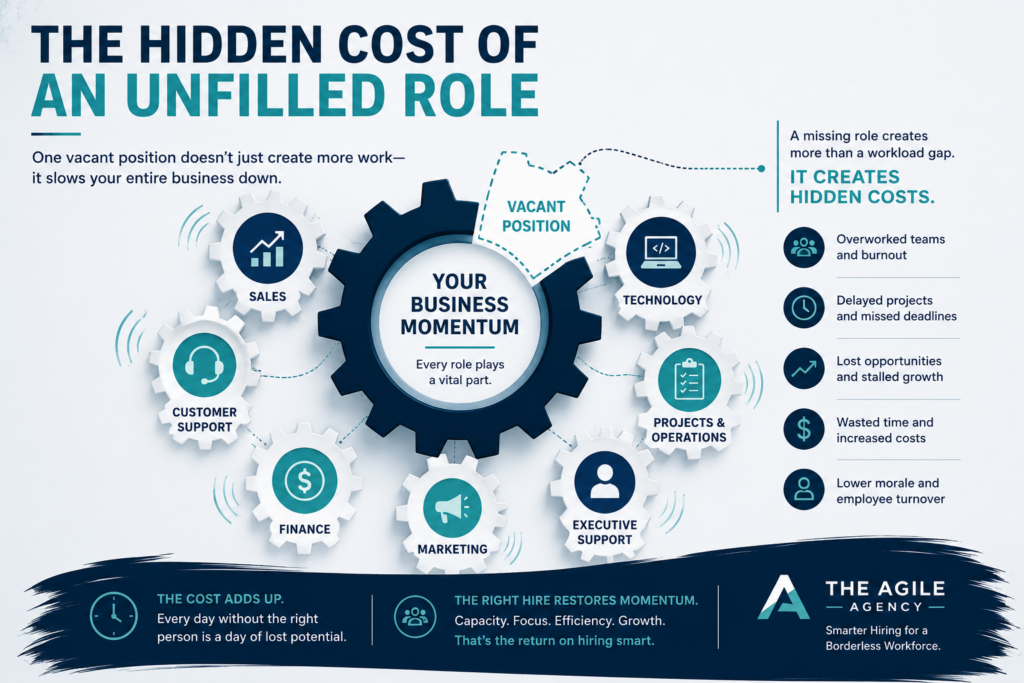
    Every week a critical position remains vacant, your business is quietly paying a price that rarely appears on a financial statement.

    And over time, that hidden cost compounds.


    The Opportunity Cost Nobody Measures

    When a role sits unfilled, most leaders focus on the money they’re saving.

    “We haven’t added another salary.”

    But they’re overlooking what they’re losing.

    An unfilled role often means:

    • Customers waiting longer for responses.
    • Sales opportunities going untouched.
    • Leadership spending time on operational work instead of strategic growth.
    • Existing employees absorbing additional responsibilities.

    The salary may be absent from the budget.

    The productivity loss is not.


    When Your Best Employees Become Your Backup Plan

    One of the first consequences of vacant positions is that high-performing employees begin carrying the extra workload.

    Initially, they step up.

    They’re dependable.

    They’re committed.

    But over time, something changes.

    Their own priorities begin slipping.

    Projects slow down.

    Stress increases.

    Job satisfaction declines.

    Eventually, your strongest employees become your most vulnerable to burnout.

    Ironically, trying to save one salary can eventually cost you your top performer.


    The Founder Trap

    For entrepreneurs, the impact is even greater.

    Instead of focusing on:

    • Building partnerships
    • Meeting prospective clients
    • Improving products
    • Expanding into new markets

    Founders find themselves:

    • Managing inboxes
    • Scheduling meetings
    • Updating spreadsheets
    • Following up on administrative tasks

    None of these activities are unimportant.

    But they are rarely the highest and best use of a founder’s time.

    Every hour spent on administrative execution is an hour not spent growing the business.


    The Domino Effect of Delayed Hiring

    Vacant positions rarely affect only one department.

    They ripple throughout the organization.

    A delayed marketing hire slows lead generation.

    Reduced lead generation limits sales opportunities.

    Lower sales impact cash flow.

    Cash flow delays additional hiring.

    The cycle repeats.

    What began as one vacant position becomes a company-wide growth constraint.


    Why Speed Matters More Than Ever

    Today’s hiring market moves quickly.

    Top candidates are often evaluating multiple opportunities simultaneously.

    Organizations that take weeks to make decisions frequently lose exceptional talent – not because their offer wasn’t attractive, but because another company simply moved faster.

    Building an efficient hiring process is no longer just an HR improvement.

    It’s a competitive advantage.


    Global Hiring Changes the Equation

    For many small and mid-sized businesses, the challenge isn’t recognizing the need for additional help.

    It’s believing they can afford it.

    Global hiring has changed that calculation.

    Instead of postponing critical roles until revenue reaches a certain threshold, businesses can often access highly qualified professionals for functions such as:

    • Executive assistance
    • Customer support
    • Marketing coordination
    • Bookkeeping
    • Project management
    • Software development
    • Data analysis

    The result isn’t simply lower labor costs.

    It’s earlier operational capacity.

    And earlier capacity often leads to earlier growth.


    Questions Every Business Owner Should Ask

    Rather than asking:

    “Can we afford to hire?”

    Consider asking:

    • What revenue opportunities are we missing because this role isn’t filled?
    • What work is my leadership team doing that someone else could own?
    • Which projects have been delayed because we lack capacity?
    • What would change if this position were filled within the next 30 days?

    Those answers often reveal a very different financial picture.


    The Best Hiring Decisions Aren’t Reactive

    Many companies wait until they’re overwhelmed before adding talent.

    By then:

    • Service levels have already declined.
    • Employees are already exhausted.
    • Growth has already slowed.

    The strongest organizations hire proactively.

    They build capacity before they desperately need it.

    That allows growth to continue without constant operational strain.


    Final Thought

    Hiring isn’t simply about filling seats.

    It’s about creating capacity.

    Every strategically filled role gives your business something valuable:

    More time.

    More focus.

    More consistency.

    More opportunity to grow.

    The true question isn’t whether hiring costs money.

    It’s whether your business can continue absorbing the hidden cost of doing without the right people.

    Because in today’s market, the most expensive employee may not be the one you hire.

    It may be the one you never hired.


    For Founders and Business Leaders

    The next time you postpone hiring, ask yourself one question:

    “What is this vacant position already costing my business?”

    You may discover the answer is far greater than the salary you were hoping to save.

  • Why Employee Retention Starts Long Before Your First Day of Work

    Why Employee Retention Starts Long Before Your First Day of Work

    When companies discuss employee retention, the conversation usually revolves around compensation, benefits, culture or engagement.

    While all of those matter, they overlook a more fundamental truth:

    Retention doesn’t begin on an employee’s first day.

    It begins the moment you decide to create the role.

    Many organizations spend significant resources trying to retain employees after they’re hired, when the real opportunity lies in building a hiring process that attracts – and keeps – the right people from the start.

    Retention is not simply an HR initiative.

    It is the outcome of thoughtful workforce design.


    The Cost of Employee Turnover

    Replacing an employee is expensive.

    Beyond recruiting costs, turnover creates ripple effects throughout the organization:

    • Lost productivity during the vacancy
    • Additional workload for existing team members
    • Increased management time
    • Delayed projects
    • Higher training and onboarding costs
    • Reduced customer continuity

    Frequent turnover also affects morale. High-performing employees often become frustrated when they repeatedly absorb additional responsibilities while new team members are recruited and trained.

    Retention isn’t just about reducing costs.

    It’s about protecting momentum.


    Most Turnover Is Predictable

    Employees rarely leave because of one isolated event.

    More often, turnover results from expectations that were never aligned in the first place.

    Consider questions like:

    • Was the role clearly defined?
    • Did the employee understand what success looked like?
    • Were performance expectations realistic?
    • Did the job match what was described during recruitment?
    • Was the onboarding process structured?

    When these questions aren’t addressed before hiring, dissatisfaction becomes much more likely.


    Hiring for Alignment, Not Just Ability

    Technical skills matter.

    Experience matters.

    But long-term retention depends on something equally important:

    Alignment.

    Alignment includes:

    • Understanding the company’s mission
    • Clear communication expectations
    • Role clarity
    • Work style compatibility
    • Professional goals
    • Readiness for remote or hybrid work

    An exceptionally skilled professional who is poorly aligned with the role often leaves – or underperforms.

    Conversely, someone who is well aligned with the organization’s expectations frequently grows into a high-performing, long-term contributor.


    Onboarding Is Your First Opportunity to Build Trust

    A strong onboarding process does more than introduce policies and procedures.

    It communicates confidence.

    New employees should quickly understand:

    • Their responsibilities
    • Who they report to
    • How success will be measured
    • Where to find resources
    • How communication flows throughout the organization

    The faster employees gain clarity, the faster they become productive.

    Confusion creates anxiety.

    Clarity creates confidence.


    Leadership Plays a Bigger Role Than Perks

    Competitive salaries and attractive benefits are important, but they are rarely the sole reason employees stay.

    People also remain where they feel:

    • Valued
    • Trusted
    • Supported
    • Challenged appropriately
    • Connected to meaningful work

    Strong leadership creates an environment where people understand how their work contributes to larger business objectives.

    Purpose increases commitment.


    Retention in Remote Teams Requires Greater Intention

    Distributed teams don’t benefit from spontaneous conversations in hallways or shared office experiences.

    Connection must be created intentionally.

    Successful remote organizations establish:

    • Regular one-on-one meetings
    • Clear communication rhythms
    • Recognition for achievements
    • Opportunities for professional development
    • Consistent feedback

    Remote employees thrive when they feel informed, connected and trusted.


    The Agile Agency Approach

    At The Agile Agency, we believe employee retention begins with better hiring decisions.

    Before introducing candidates, we work with organizations to define:

    • Clear role expectations
    • Performance scorecards
    • Communication structures
    • Workflow integration
    • Success metrics

    Candidates are evaluated not only for technical capability but also for communication, professionalism and remote work readiness.

    The result is a stronger fit from the beginning.

    Better alignment leads to stronger retention.


    Building Teams That Stay and Grow

    Retention isn’t about convincing people to stay after they’ve become unhappy.

    It’s about creating an environment where leaving becomes less likely because expectations, support and opportunity were established from the very beginning.

    The organizations with the strongest retention rates don’t simply hire talented people.

    They build systems that allow talented people to succeed.

    That’s the difference between filling positions and building a workforce.


    Final Thoughts

    Every hiring decision shapes the future of your organization.

    When hiring, onboarding and leadership are intentionally designed, employee retention becomes a natural outcome—not a constant challenge.

    The companies that win the competition for talent won’t necessarily be those offering the highest salaries.

    They’ll be the ones creating workplaces where great people can do their best work, grow professionally and see a future.

    Retention starts long before day one.

    It starts with the way you hire.


    Building a high-performing team doesn’t end when an offer is accepted – it begins there.

    At The Agile Agency, we help businesses build global teams designed for long-term success through thoughtful role design, rigorous candidate evaluation and structured workforce strategies.

    If you’re ready to hire with retention in mind, let’s start building your next great team together.

  • Why Hiring Generalists Is Costing Your Business More Than You Think

    Why Hiring Generalists Is Costing Your Business More Than You Think

    As businesses grow, one hiring mistake appears again and again:

    “We need someone who can do a little bit of everything.”

    The logic seems sound.

    Hire one person instead of three.

    Save money.

    Stay lean.

    Move faster.

    In the earliest stages of a business, that approach is often necessary.

    Founders themselves are generalists.

    They sell, market, recruit, solve customer issues, and manage operations – all before lunch.

    But what works during the startup phase rarely works during the scaling phase.

    As companies grow, the “do-it-all” employee often becomes a bottleneck rather than a solution.


    The Hidden Cost of the Generalist Role

    Generalists bring tremendous value in dynamic environments.

    They adapt quickly, wear multiple hats, and help organizations navigate uncertainty.

    But problems arise when companies expect one person to perform several specialized jobs at a consistently high level.

    For example:

    • An executive assistant who is also expected to manage marketing.
    • A software engineer responsible for customer support.
    • An accountant running HR and payroll.
    • A project manager creating graphic design assets.

    None of these combinations are impossible.

    They’re simply inefficient over time.


    Jack of All Trades, Master of None

    Every professional has strengths.

    The challenge is asking them to operate outside those strengths for too much of their workweek.

    When employees constantly switch between unrelated responsibilities:

    • Context switching increases.
    • Productivity declines.
    • Quality becomes inconsistent.
    • Stress rises.
    • Burnout becomes more likely.

    The result isn’t greater efficiency.

    It’s fragmented performance.


    The Rise of Specialized Global Teams

    One of the biggest advantages of global hiring is access to specialized talent.

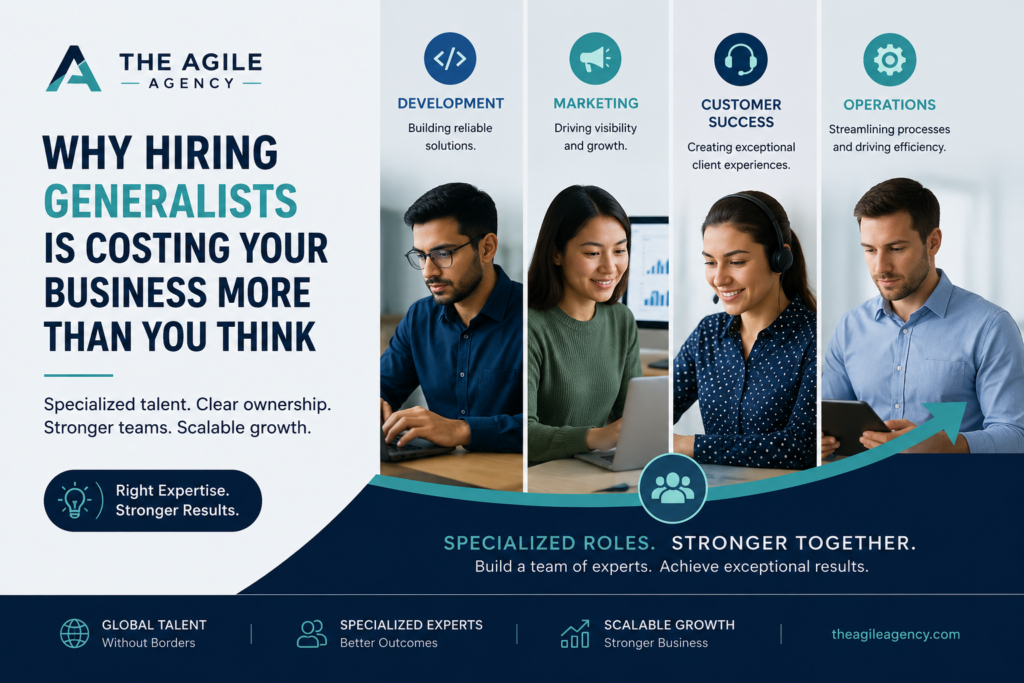
    Instead of searching locally for one employee who can do everything, companies can build lean teams of experts.

    For example:

    A growing technology company might have:

    • A software engineer focused solely on development.
    • A customer success specialist managing client relationships.
    • A marketing coordinator handling content and campaigns.
    • A virtual executive assistant managing operations.

    Each role has clear ownership.

    Each professional works within their area of expertise.

    And the business benefits from higher-quality execution.


    Why Specialization Accelerates Growth

    Specialists generally:

    • Develop deeper expertise.
    • Produce higher-quality work.
    • Solve problems faster.
    • Require less oversight within their discipline.

    That doesn’t mean generalists aren’t valuable.

    It means businesses should match talent to the stage they’re in.

    Early-stage companies often need adaptable generalists.

    Scaling companies increasingly benefit from focused specialists.


    Signs Your Team Needs Greater Specialization

    You may be reaching the limits of the generalist model if:

    • Projects are consistently delayed.
    • Employees seem overwhelmed.
    • Quality varies from week to week.
    • Leadership spends excessive time answering operational questions.
    • Team members frequently switch priorities throughout the day.

    These are often structural issues—not performance issues.


    How Global Hiring Makes Specialization Affordable

    In the past, building specialized teams often required significant payroll expansion.

    Today, businesses have another option.

    Global hiring enables companies to access skilled professionals across a wide range of disciplines while maintaining financial flexibility.

    Rather than overloading one employee with five responsibilities, organizations can distribute work among professionals whose primary expertise matches the task.

    This often leads to:

    • Better quality.
    • Faster execution.
    • Higher employee satisfaction.
    • Greater operational resilience.

    Building Roles Around Outcomes

    Instead of asking:

    “Who can do all of these jobs?”

    Ask:

    “What business outcomes do we need to achieve?”

    From there, identify the expertise required to produce those outcomes consistently.

    Clear roles create:

    • Better accountability.
    • Better hiring decisions.
    • Better performance.

    The Leadership Shift

    One hallmark of effective leadership is recognizing when the organization has outgrown its original operating model.

    Many founders continue hiring generalists because that’s how they built the company.

    But scaling requires a different mindset.

    Growth often comes from designing systems where specialists collaborate – not where individuals carry every responsibility alone.


    Final Thought

    Generalists help build businesses.

    Specialists often help scale them.

    Neither approach is inherently better.

    The key is understanding which one your business needs today.

    As your company grows, asking one person to do everything rarely saves money.

    More often, it slows growth, reduces quality, and limits your ability to scale.

    The most successful organizations don’t simply hire more people.

    They hire the right expertise for the right responsibilities.


    For Founders and Operators

    Before creating your next job description, ask yourself:

    • Are we hiring one person to solve five different problems?
    • Which responsibilities truly require specialized expertise?
    • What would improve if every critical function had clear ownership?

    Because sustainable growth isn’t built by asking people to do everything.

    It’s built by creating teams where everyone can do their best work.

  • Beyond Cost Savings: Why Access to Global Talent Is Becoming a Competitive Advantage

    Beyond Cost Savings: Why Access to Global Talent Is Becoming a Competitive Advantage

    For years, international hiring has largely been viewed through one lens:

    Cost reduction.

    Companies expanded their talent search internationally because they believed they could reduce payroll expenses.

    While lower labor costs can certainly improve financial performance, focusing solely on cost overlooks a much bigger opportunity.

    Today’s most successful organizations aren’t hiring globally because talent is cheaper.

    They’re hiring globally because talent is scarce.

    The companies that recognize this shift are building stronger, more innovative and more resilient organizations.


    The Talent Shortage Is No Longer Temporary

    Across many industries, finding qualified professionals has become increasingly difficult.

    Companies continue to face challenges filling positions in areas such as:

    • Software development
    • Information technology
    • Cybersecurity
    • Data analytics
    • Digital marketing
    • Accounting and finance
    • Engineering
    • Customer success
    • Administrative support

    The issue isn’t simply a lack of applicants.

    It’s a shortage of qualified professionals with the skills businesses need.

    Waiting months to fill critical positions slows growth, delays projects and increases pressure on existing employees.


    The World’s Talent Pool Is Larger Than Your Zip Code

    One of the biggest advantages of remote work is that geography is no longer the primary limitation.

    Instead of searching within commuting distance of your office, companies can access qualified professionals across multiple countries and continents.

    This dramatically increases the available talent pool.

    Rather than competing with hundreds of local employers for the same candidates, businesses can identify exceptional professionals in markets where talent is abundant but opportunities may be limited.

    This creates value for both employers and employees.


    Diversity of Experience Drives Better Business Decisions

    Hiring globally is about more than expanding headcount.

    It also introduces broader perspectives into your organization.

    Professionals from different countries often bring unique experiences, educational backgrounds and problem-solving approaches.

    These diverse viewpoints can improve:

    • Innovation
    • Product development
    • Customer service
    • Process improvement
    • Strategic decision-making

    Companies serving global markets benefit significantly from teams that understand different cultures and customer expectations.


    Business Continuity Through Geographic Diversification

    Many companies discovered during recent global disruptions that concentrating an entire workforce in one location creates unnecessary risk.

    Distributed teams provide greater operational resilience.

    If one region experiences:

    • Severe weather
    • Infrastructure disruptions
    • Political instability
    • Power outages

    Teams located elsewhere can often continue operations with minimal interruption.

    Global workforce diversification has become an important component of business continuity planning.


    Around-the-Clock Productivity

    One often overlooked benefit of global hiring is the ability to extend business operations across time zones.

    Rather than stopping work at 5:00 p.m., companies can create workflows that continue moving forward while headquarters is offline.

    Examples include:

    • Software development
    • Customer support
    • Marketing execution
    • Administrative processing
    • Financial reporting

    This continuous workflow reduces project timelines and increases responsiveness.

    The result is greater operational efficiency without requiring employees to work excessive hours.


    Global Hiring Requires Intentional Leadership

    Access to worldwide talent alone does not create a competitive advantage.

    Companies must intentionally build systems that support distributed teams.

    Successful organizations establish:

    • Clear communication expectations
    • Documented workflows
    • Defined performance metrics
    • Consistent onboarding processes
    • Strong management practices

    When these foundations are in place, global teams often outperform traditional office-based structures.


    The Agile Agency Approach

    At The Agile Agency, we believe global hiring should be driven by opportunity – not just economics.

    Our focus is helping companies identify professionals who bring the technical expertise, communication skills and remote work readiness required to contribute from day one.

    We work with organizations to build workforce strategies that support:

    • Sustainable growth
    • Operational efficiency
    • Long-term scalability
    • Cross-border collaboration

    Our goal isn’t simply to help companies hire internationally.

    Our goal is to help them build stronger businesses through better workforce design.


    The Future Belongs to Companies That Think Globally

    The organizations that thrive over the next decade won’t necessarily be the ones with the largest recruiting budgets.

    They will be the ones willing to rethink where talent comes from.

    Global hiring is no longer just a staffing strategy.

    It is a business strategy.

    Companies that embrace a worldwide talent mindset will have access to more ideas, greater flexibility and stronger long-term resilience than those limiting themselves to local labor markets.

    In today’s economy, competitive advantage isn’t defined by where your office is located.

    It’s defined by where you’re willing to find great people.


    If your business is struggling to find qualified talent locally, it may be time to expand your search beyond borders.

    The Agile Agency helps businesses build high-performing global teams by connecting them with vetted professionals who are ready to contribute from day one.

    Let’s build a workforce that supports your next stage of growth.