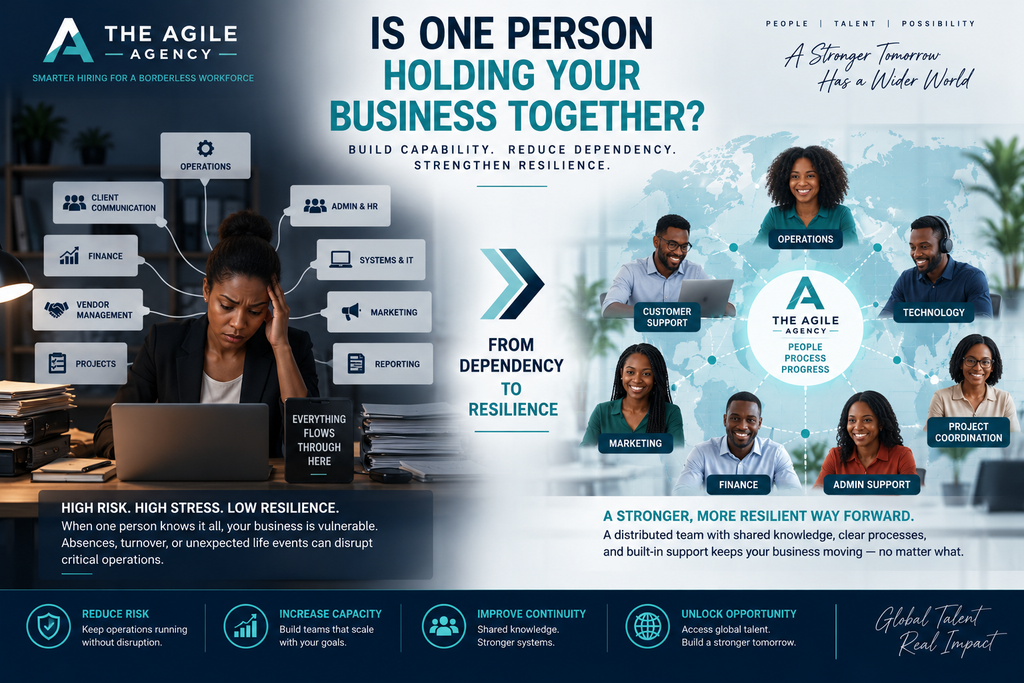
The Single-Point-of-Failure Employee: The Workforce Risk Growing Businesses Rarely See Until It’s Too Late
Every growing company has one.
The person who knows how everything works.
They know the passwords.
They know the client history.
They know why the spreadsheet is structured that way.
They know which vendor actually responds.
They know the workaround nobody documented.
They know what has to happen at the end of every month—and what breaks if it doesn’t.
When something goes wrong, everyone says:
“Ask them.”
At first, this employee feels invaluable.
And they probably are.
But eventually, something else becomes true:
They become a single point of failure.
If one person’s absence can stop a critical business function, the company doesn’t simply have a staffing problem.
It has a workforce resilience problem.
And for growing businesses, that risk can quietly become enormous.
Your Best Employee Can Also Be Your Greatest Operational Vulnerability
This isn’t an argument against exceptional employees.
Quite the opposite.
Strong employees naturally accumulate knowledge and responsibility.
They solve problems.
Leadership trusts them.
Colleagues depend on them.
Customers learn to call them.
Over time, more work flows in their direction precisely because they’re reliable.
That’s how dependency develops.
The problem isn’t that someone has become highly valuable.
The problem is that the organization hasn’t converted that person’s knowledge into organizational capability.
There is a critical difference.
An employee can leave.
Organizational capability remains.
At least, it should.
The “What Happens If They’re Gone Tomorrow?” Test
Here’s a useful exercise for every founder and business leader.
Look at each critical function in your company and ask:
If this person were unexpectedly unavailable tomorrow, what would stop?
Not permanently.
Just tomorrow.
Could someone else:
Access the necessary systems?
Respond to the customer?
Run payroll?
Update the website?
Prepare the report?
Process the order?
Manage the vendor?
Resolve the technical issue?
Continue the project?
If the answer repeatedly becomes:
“No one else knows how,”
you’ve identified operational concentration risk.
And the smaller the company, the more dangerous that concentration can become.
Small Businesses Are Especially Vulnerable
Large organizations usually have some degree of redundancy.
There are departments.
Multiple employees understand similar functions.
Processes are documented.
Responsibilities can be reassigned.
Growing businesses often operate differently.
One person may effectively function as:
Operations coordinator.
CRM administrator.
Customer support lead.
Project manager.
Executive assistant.
Vendor liaison.
And unofficial keeper of institutional memory.
That arrangement can work remarkably well—until it doesn’t.
An employee doesn’t even have to resign for the vulnerability to appear.
They could:
Take a vacation.
Become ill.
Go on parental leave.
Move into another role.
Experience a family emergency.
Become overwhelmed.
Or simply become unavailable during a critical moment.
A resilient business should be able to absorb normal human events without operational paralysis.
Busyness Can Hide Fragility
One of the most dangerous misconceptions in workforce planning is:
“Everything is getting done, so the system must be working.”
Not necessarily.
Sometimes everything is getting done because one highly capable person is compensating for a poorly designed system.
They’re remembering deadlines manually.
They’re fixing mistakes before leadership notices.
They’re answering questions after hours.
They’re maintaining undocumented processes.
They’re carrying responsibilities that should belong to several functions.
From the outside, operations look efficient.
Underneath, the company may be extraordinarily fragile.
This is why workforce resilience cannot be measured only by today’s output.
You also have to evaluate what happens when today’s people change.
Documentation Is Not Bureaucracy. It’s Business Continuity.
Many growing companies resist documentation because it feels corporate.
“We’re too small for all that.”
“We don’t need a manual.”
“Everyone knows what they’re doing.”
Until everyone doesn’t.
Documentation doesn’t require creating hundreds of pages of procedures.
It means ensuring critical organizational knowledge exists somewhere other than inside someone’s head.
At minimum, important functions should have documented:
- Core responsibilities
- Recurring processes
- Key deadlines
- System access requirements
- Vendor and client handoffs
- Escalation procedures
- Decision authorities
- Backup ownership
The goal isn’t paperwork.
The goal is continuity.
Cross-Training Is an Insurance Policy You Can Actually Use
Documentation is one layer.
Cross-training is another.
A written procedure is helpful.
A second person who has actually performed the procedure is better.
For every business-critical responsibility, leadership should know:
Who owns it?
And:
Who can cover it?
That doesn’t mean duplicating every position.
It means creating enough knowledge overlap that normal disruption doesn’t become an emergency.
A finance professional may have a backup for monthly reporting.
An executive assistant may cross-train someone on critical calendar or travel procedures.
A customer support specialist may document escalation protocols another team member can follow.
A technical employee may ensure key system configurations aren’t understood by only one person.
Resilience comes from intentional overlap, not unnecessary headcount.
The Founder Is Often the Biggest Single Point of Failure
This conversation becomes uncomfortable when we move beyond employees.
Because in many small businesses, the largest concentration risk isn’t a team member.
It’s the founder.
The founder approves everything.
The founder owns every important relationship.
The founder knows every password.
The founder resolves every exception.
The founder closes major sales.
The founder makes every financial decision.
The founder holds the institutional history.
The business may employ ten people and still be operationally dependent on one.
That’s not scale.
That’s a larger organization orbiting the same bottleneck.
Building workforce resilience therefore isn’t merely about protecting the company from employee departures.
It’s also about building a company that can increasingly function without constant founder intervention.
Global Teams Can Strengthen Business Continuity
This is where global workforce strategy offers an advantage that receives far less attention than cost savings.
Distributed teams can create operational redundancy.
When responsibilities are intentionally designed across people, functions, and sometimes geographies, businesses become less dependent on one individual or one operating window.
For example, a company might have:
A U.S.-based leader responsible for strategy and client relationships.
A global operations professional maintaining workflows and documentation.
A customer support professional managing service requests.
A finance professional maintaining reporting and reconciliations.
A technical professional managing systems.
The point isn’t to distribute work simply because people are located in different countries.
The point is to build multiple layers of organizational capability.
Global hiring can make that architecture financially accessible earlier in a company’s growth.
But Adding People Does Not Automatically Create Resilience
This distinction matters.
A company can have 50 employees and still have enormous single-person dependencies.
Headcount isn’t resilience.
System design is.
If one employee remains the only person who understands a critical process, adding three unrelated hires doesn’t solve the problem.
If information remains trapped in private inboxes, adding more employees doesn’t solve the problem.
If passwords are shared informally, adding more employees doesn’t solve the problem.
If nobody knows who owns what, adding more employees may actually make the situation worse.
Resilience requires intentional workforce architecture.
Build Roles Around Ownership – and Backup Ownership
Most job descriptions answer one question:
What does this employee do?
A more resilient organization answers another:
What happens when this employee can’t do it?
That doesn’t mean every employee needs a substitute sitting beside them.
It means critical functions should have continuity built into their design.
For each essential process, determine:
Primary owner: Who is accountable?
Backup owner: Who can maintain continuity?
Documentation: Where does the process live?
Access: Who has the appropriate permissions?
Escalation: Who makes decisions when the primary owner is unavailable?
Recovery: How quickly can another person take over?
That’s workforce planning.
Not simply hiring.
Institutional Knowledge Should Belong to the Company
Employees accumulate enormous knowledge over time.
That’s valuable.
But organizations make a mistake when they allow that knowledge to remain entirely personal.
A strong employee should leave the organization more capable because they worked there.
Their improvements should become:
Processes.
Templates.
Documentation.
Systems.
Training.
Standards.
Lessons learned.
That’s how individual expertise becomes institutional knowledge.
And institutional knowledge compounds.
Offboarding Should Begin Long Before Someone Resigns
Most companies begin thinking about knowledge transfer after receiving a resignation letter.
By then, the clock is running.
Two weeks isn’t much time to reconstruct years of undocumented knowledge.
A better approach is to build transferability into normal operations.
Processes are documented while they’re being performed.
Important information lives in shared systems.
Responsibilities are visible.
Team members occasionally cross-train.
Access is structured by role.
Projects have clear status documentation.
Then, when someone eventually leaves—as every employee ultimately will—the organization isn’t beginning from zero.
The transition becomes manageable instead of chaotic.
Resilience Does Not Mean Employees Are Disposable
There is an important distinction here.
Building redundancy should never communicate:
“Anyone can be replaced.”
Great employees are not interchangeable.
Their judgment, relationships, experience, creativity, and leadership can be extraordinarily difficult to replace.
Workforce resilience acknowledges that reality while protecting the organization from operational dependency.
The message is not:
“We don’t need you.”
It is:
“Your contribution is important enough that the systems you build should survive and continue creating value.”
That’s a very different philosophy.
The Workforce Resilience Audit
Founders and business leaders can begin with a simple review.
Choose the ten most important recurring processes in your company.
Then ask:
- Who currently owns each process?
- Is the process documented?
- Can another person perform it?
- Does the backup have the necessary access?
- Where is the critical information stored?
- What happens if the primary owner is unavailable for two weeks?
- Which process would create the greatest disruption if it stopped?
The answers will reveal where your real workforce vulnerabilities live.
You may discover that your next hiring priority isn’t simply another person to handle growing volume.
It may be someone who helps remove a dangerous concentration of responsibility.
From Headcount Planning to Capability Planning
Traditional workforce planning often sounds like this:
“We need three more employees.”
A more sophisticated approach asks:
“What capabilities does the business need to possess?”
Customer support capability.
Financial reporting capability.
Technology capability.
Operational capability.
Marketing capability.
Project management capability.
Executive support capability.
Then leadership determines how those capabilities should be distributed across the organization.
This is particularly important for smaller companies because every hiring decision shapes the architecture of the business.
You’re not simply filling seats.
You’re deciding where knowledge, responsibility, authority, and risk will live.
Final Thought
The strongest employee in your organization may be doing extraordinary work.
Celebrate that.
Reward it.
Develop them.
But don’t build a company that cannot function without them.
And don’t build one that cannot function without you.
A resilient organization transforms individual expertise into shared capability.
It documents what matters.
It cross-trains where necessary.
It creates backup ownership.
It distributes knowledge intentionally.
And it treats business continuity as part of workforce strategy—not something to address after a crisis.
Because growth isn’t simply about how much your team can accomplish when everyone is present.
It’s also about how well the business continues when someone isn’t.
For Founders and Business Leaders
Here’s the question I’d put on the agenda at your next leadership meeting:
“If one person disappeared from our organization for 30 days, whose absence would create the greatest operational disruption?”
Whatever name immediately comes to mind deserves attention.
Not because that employee is a problem.
Because you’ve probably just identified a structural dependency in the business.
The goal isn’t to make great people less important.
It’s to make the organization they helped build more resilient.
About The Agile Agency
The Agile Agency connects U.S. businesses with vetted African professionals across technology, IT and systems support, education, customer support, executive and administrative support, operations, project coordination, finance and accounting, marketing and content, data, research, and analytics.
We help businesses think beyond filling vacancies toward building capable, distributed teams designed for sustainable growth.
Smarter Hiring for a Borderless Workforce.
Leave a Reply