Hiring the right person is only half the work.
The other half begins after the offer is accepted.
Many companies invest significant time identifying, interviewing, and selecting strong candidates, only to lose momentum during onboarding. The new hire arrives ready to contribute, but the organization is not prepared to integrate them effectively.
There is no structured introduction.
Expectations are unclear.
Access to systems is delayed.
Managers assume the employee will “figure things out.”
Then, within a few weeks, frustration begins on both sides.
The company starts questioning the hire.
The employee starts questioning the company.
What appears to be a performance problem is often an onboarding problem.
For remote and global teams, the first 90 days are especially important. Distance removes many of the informal learning opportunities that exist in a traditional office, which means companies must replace them with deliberate structure.
Onboarding Is Not an Orientation Call
Many businesses confuse onboarding with administration.
They send an employment agreement.
They create an email address.
They schedule an introductory meeting.
They share a few documents.
Then they expect productivity to begin.
Those steps are necessary, but they do not constitute a complete onboarding process.
Effective onboarding should help a new employee understand:
- Why the company exists
- How the business operates
- What their role is responsible for
- What success looks like
- How decisions are made
- Who they should communicate with
- What they are expected to accomplish first
Without that clarity, even highly capable professionals can struggle.
Why Remote Employees Need More Structure
In a physical office, a new employee can observe how people work.
They can listen to conversations.
They can ask a colleague a quick question.
They can see how managers respond to challenges.
Remote employees do not have the same access to context.
They cannot absorb the company culture by walking through the workplace.
They cannot easily tell which tasks are urgent, which processes are flexible, or which decisions require approval.
As a result, remote onboarding must be more intentional than in-person onboarding.
Not more complicated.
More explicit.
The Cost of Weak Onboarding
Poor onboarding creates problems that extend far beyond the new hire.
1. Slower Time to Productivity
When employees lack the information, tools, or context they need, they take longer to become effective.
Managers then spend more time correcting work, repeating instructions, and answering preventable questions.
2. Reduced Confidence
New employees want to make a strong impression.
When expectations are unclear, they become hesitant.
They may delay decisions, avoid taking initiative, or over-rely on management because they are unsure what authority they have.
3. Early Disengagement
Employees begin forming opinions about an organization immediately.
A disorganized first week can signal that the company lacks structure, communication, or respect for their time.
That impression can be difficult to reverse.
4. Increased Turnover Risk
Many early departures are not caused by compensation.
They are caused by unmet expectations, poor communication, and the feeling that the employee was never properly set up to succeed.
Replacing that employee means restarting the entire recruitment process.
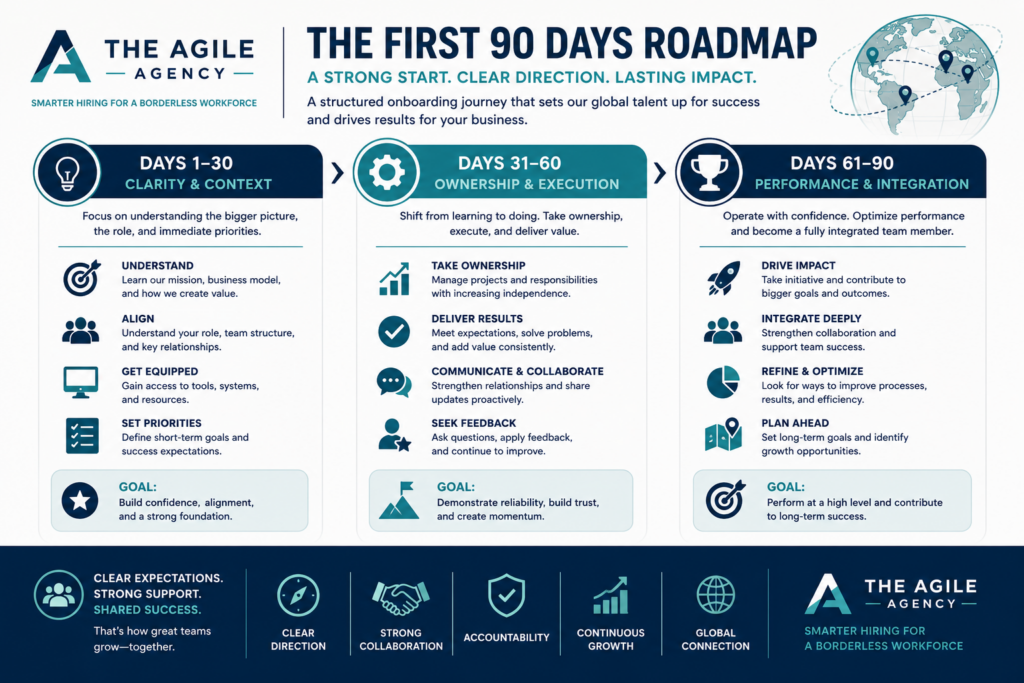
The First 90 Days Should Be Designed in Stages
A strong onboarding process should not overwhelm the employee with everything at once.
It should build competence progressively.
Days 1–30: Clarity and Context
The first month should focus on understanding.
The employee needs to learn:
- The company’s mission and business model
- The purpose of their role
- Core systems and tools
- Communication expectations
- Team structure
- Immediate priorities
- Quality standards
This is also the period for establishing trust.
Managers should create space for questions and explain not only what needs to be done, but why it matters.
The goal of the first 30 days is not maximum output.
It is alignment.
Days 31–60: Ownership and Execution
During the second month, the employee should begin taking greater responsibility.
They should move from observation to consistent execution.
At this stage, managers should evaluate:
- Accuracy
- Reliability
- Communication
- Follow-through
- Problem-solving
- Ability to apply feedback
Responsibilities should expand gradually, with clear checkpoints along the way.
The employee should understand where they can act independently and where approval is still required.
The goal is controlled ownership.
Days 61–90: Performance and Integration
By the third month, the employee should be functioning as a fully contributing member of the team.
They should understand their workflows, key relationships, reporting expectations, and performance standards.
This is the time to assess:
- Progress against role objectives
- Strengths demonstrated
- Areas requiring further development
- Long-term fit
- Additional training needs
- Opportunities for expanded responsibility
The 90-day review should not be the first serious performance conversation.
It should be the culmination of regular feedback provided throughout the onboarding period.
What Strong Onboarding Includes
High-performing companies usually provide several essential components.
A Clear Role Scorecard
The employee should know exactly what outcomes they are responsible for producing.
A strong scorecard may include:
- Primary responsibilities
- Weekly or monthly deliverables
- Performance metrics
- Quality expectations
- Reporting relationships
- Decision-making authority
This eliminates ambiguity from the beginning.
A Structured Training Plan
Training should be sequenced.
Employees should not receive a folder containing dozens of documents and be expected to determine what matters most.
A better process includes:
- Required reading in priority order
- System demonstrations
- Recorded training where appropriate
- Practical assignments
- Guided review of completed work
- Clear milestones
Immediate Access to Tools
Technology delays create avoidable frustration.
Before the employee starts, the company should prepare:
- Email access
- Project management tools
- Communication platforms
- Shared drives
- Required software
- Security protocols
- Password management systems
A new employee should not spend their first week waiting for access.
Defined Communication Rhythms
Remote employees need to know how communication works.
That includes:
- When meetings occur
- Which platform is used for which purpose
- How quickly messages should be answered
- When issues should be escalated
- How progress should be reported
- Who makes final decisions
Communication should not depend on guesswork.
Early Feedback
Managers often wait too long to correct small issues.
By the time formal feedback is given, poor habits may already be established.
Early feedback should be:
- Specific
- Timely
- Constructive
- Connected to clear expectations
Employees generally adjust faster when they know exactly what needs to improve.
Global Onboarding Requires Cultural Intelligence
When hiring internationally, companies must also account for differences in communication, hierarchy, and workplace norms.
For example, some employees may be less likely to challenge a manager directly.
Others may interpret silence as approval.
Some may wait for explicit instructions rather than act independently.
These are not necessarily performance deficiencies.
They may reflect different professional or cultural expectations.
Strong global managers clarify:
- Whether questions are encouraged
- How disagreement should be expressed
- What initiative looks like
- When employees should make decisions independently
- How feedback is delivered
Cultural intelligence does not mean lowering standards.
It means communicating those standards in a way that can be understood and applied consistently.
Managers Must Own the Onboarding Process
Onboarding cannot be delegated entirely to human resources or administrative staff.
The direct manager plays the most important role.
Managers are responsible for translating the role into daily execution.
They must provide context, priorities, feedback, and accountability.
When a manager is unavailable, inconsistent, or unclear, the employee’s development slows.
A strong onboarding system supports the manager.
It does not replace them.
The Strategic Advantage of Better Onboarding
Companies often focus heavily on improving recruitment.
But better onboarding can create equally significant results.
A well-integrated employee:
- Reaches productivity faster
- Makes fewer preventable mistakes
- Communicates more confidently
- Requires less corrective management
- Builds stronger relationships
- Is more likely to remain with the company
This creates value long after the first 90 days.
Strong onboarding transforms a successful hire into a productive, engaged, and dependable team member.
Final Thought
A great candidate does not automatically become a great employee.
That transition depends on the environment the company creates around them.
Hiring brings talent into the organization.
Onboarding turns that talent into performance.
For global and remote teams, the companies that succeed will not simply be the ones with access to the largest talent pools.
They will be the ones that know how to integrate, develop, and retain the people they hire.
For Founders and Business Leaders
Before your next employee starts, ask:
- Is their first week already planned?
- Are their priorities clearly defined?
- Will every required system be ready?
- Do they know how success will be measured?
- Is there a structured plan for their first 30, 60, and 90 days?
If the answer is no, the risk is not only that the employee may struggle.
The greater risk is that your company may misjudge a strong hire because it never gave them a fair opportunity to succeed.
The first 90 days are not an administrative period.
They are the foundation of the employee’s future performance.
Leave a Reply