Why Hiring Generalists Is Costing Your Business More Than You Think
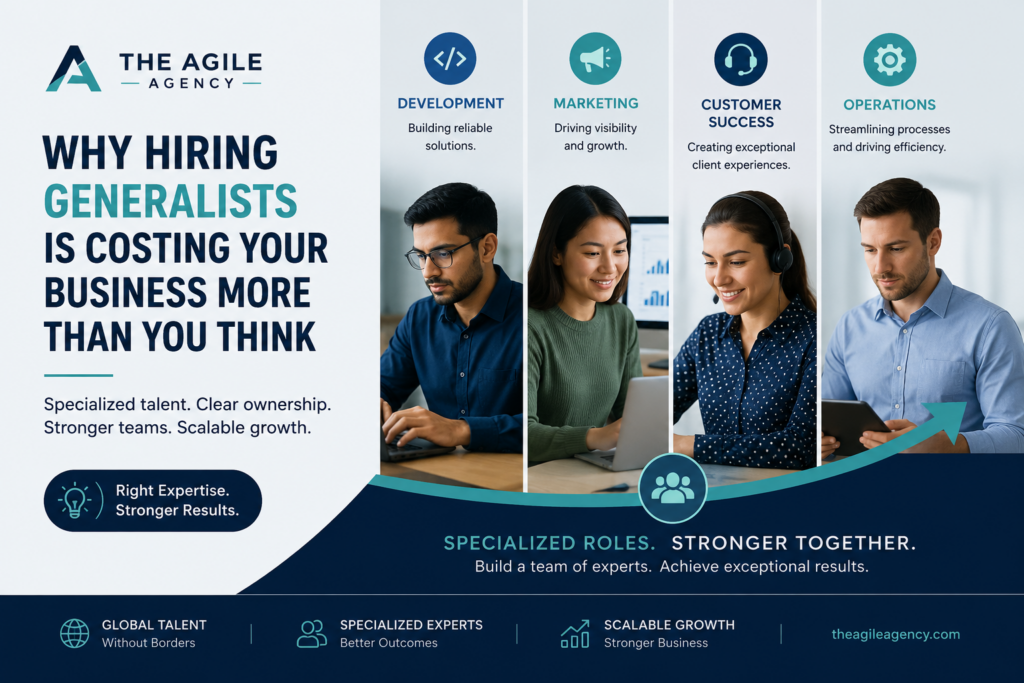
As businesses grow, one hiring mistake appears again and again:
“We need someone who can do a little bit of everything.”
The logic seems sound.
Hire one person instead of three.
Save money.
Stay lean.
Move faster.
In the earliest stages of a business, that approach is often necessary.
Founders themselves are generalists.
They sell, market, recruit, solve customer issues, and manage operations – all before lunch.
But what works during the startup phase rarely works during the scaling phase.
As companies grow, the “do-it-all” employee often becomes a bottleneck rather than a solution.
The Hidden Cost of the Generalist Role
Generalists bring tremendous value in dynamic environments.
They adapt quickly, wear multiple hats, and help organizations navigate uncertainty.
But problems arise when companies expect one person to perform several specialized jobs at a consistently high level.
For example:
- An executive assistant who is also expected to manage marketing.
- A software engineer responsible for customer support.
- An accountant running HR and payroll.
- A project manager creating graphic design assets.
None of these combinations are impossible.
They’re simply inefficient over time.
Jack of All Trades, Master of None
Every professional has strengths.
The challenge is asking them to operate outside those strengths for too much of their workweek.
When employees constantly switch between unrelated responsibilities:
- Context switching increases.
- Productivity declines.
- Quality becomes inconsistent.
- Stress rises.
- Burnout becomes more likely.
The result isn’t greater efficiency.
It’s fragmented performance.
The Rise of Specialized Global Teams
One of the biggest advantages of global hiring is access to specialized talent.
Instead of searching locally for one employee who can do everything, companies can build lean teams of experts.
For example:
A growing technology company might have:
- A software engineer focused solely on development.
- A customer success specialist managing client relationships.
- A marketing coordinator handling content and campaigns.
- A virtual executive assistant managing operations.
Each role has clear ownership.
Each professional works within their area of expertise.
And the business benefits from higher-quality execution.
Why Specialization Accelerates Growth
Specialists generally:
- Develop deeper expertise.
- Produce higher-quality work.
- Solve problems faster.
- Require less oversight within their discipline.
That doesn’t mean generalists aren’t valuable.
It means businesses should match talent to the stage they’re in.
Early-stage companies often need adaptable generalists.
Scaling companies increasingly benefit from focused specialists.
Signs Your Team Needs Greater Specialization
You may be reaching the limits of the generalist model if:
- Projects are consistently delayed.
- Employees seem overwhelmed.
- Quality varies from week to week.
- Leadership spends excessive time answering operational questions.
- Team members frequently switch priorities throughout the day.
These are often structural issues—not performance issues.
How Global Hiring Makes Specialization Affordable
In the past, building specialized teams often required significant payroll expansion.
Today, businesses have another option.
Global hiring enables companies to access skilled professionals across a wide range of disciplines while maintaining financial flexibility.
Rather than overloading one employee with five responsibilities, organizations can distribute work among professionals whose primary expertise matches the task.
This often leads to:
- Better quality.
- Faster execution.
- Higher employee satisfaction.
- Greater operational resilience.
Building Roles Around Outcomes
Instead of asking:
“Who can do all of these jobs?”
Ask:
“What business outcomes do we need to achieve?”
From there, identify the expertise required to produce those outcomes consistently.
Clear roles create:
- Better accountability.
- Better hiring decisions.
- Better performance.
The Leadership Shift
One hallmark of effective leadership is recognizing when the organization has outgrown its original operating model.
Many founders continue hiring generalists because that’s how they built the company.
But scaling requires a different mindset.
Growth often comes from designing systems where specialists collaborate – not where individuals carry every responsibility alone.
Final Thought
Generalists help build businesses.
Specialists often help scale them.
Neither approach is inherently better.
The key is understanding which one your business needs today.
As your company grows, asking one person to do everything rarely saves money.
More often, it slows growth, reduces quality, and limits your ability to scale.
The most successful organizations don’t simply hire more people.
They hire the right expertise for the right responsibilities.
For Founders and Operators
Before creating your next job description, ask yourself:
- Are we hiring one person to solve five different problems?
- Which responsibilities truly require specialized expertise?
- What would improve if every critical function had clear ownership?
Because sustainable growth isn’t built by asking people to do everything.
It’s built by creating teams where everyone can do their best work.
Leave a Reply